
Bread Before Bridges
Because communities do not survive on slogans. They survive because someone makes coffee.

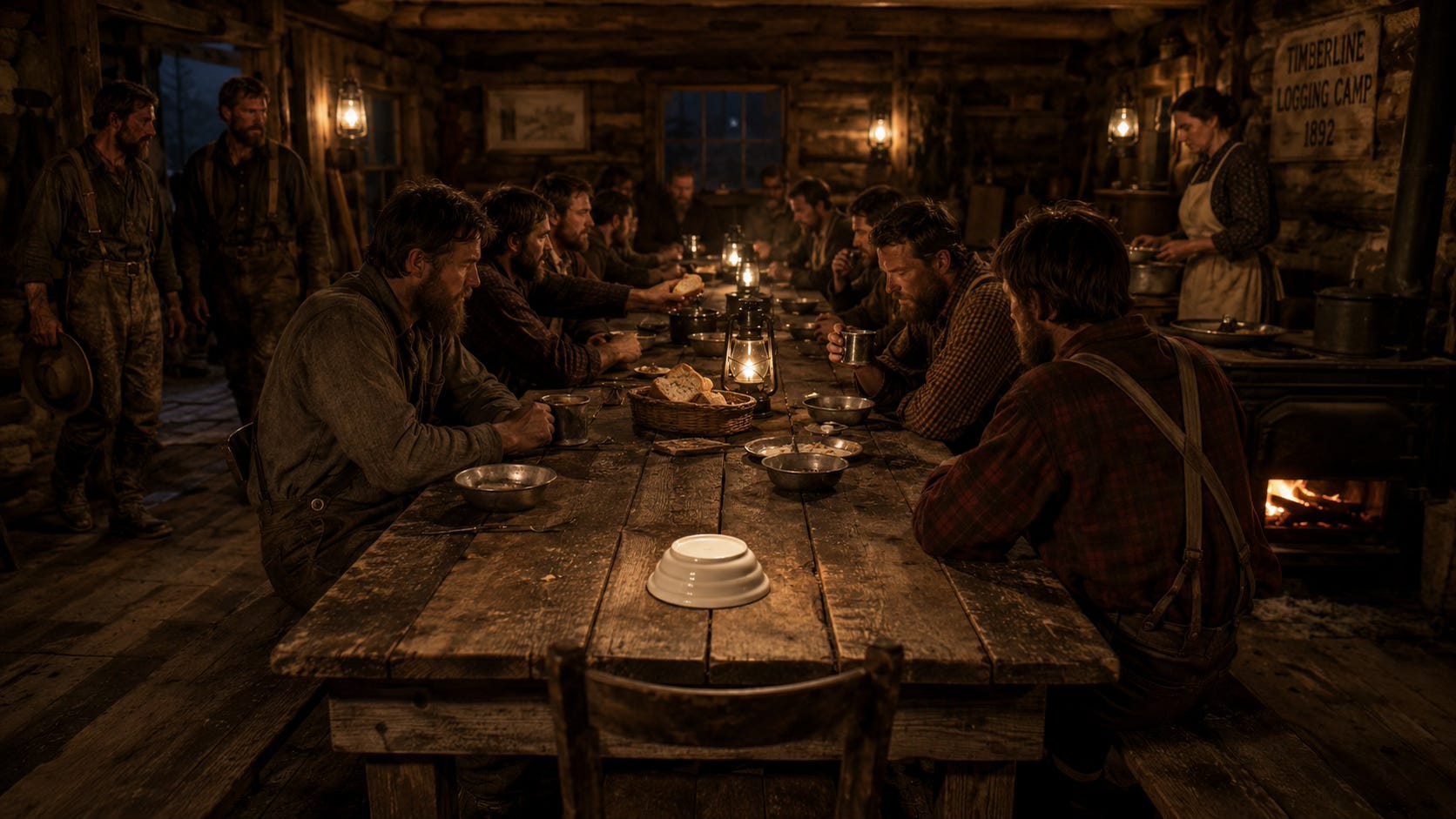
One bowl stayed upside down.
One place stayed empty.
One absence kept its chair.
Not because anyone had forgotten to set the table.
Not because Maggie O’Donnell forgot such things.
Not because Timberline had learned how to eat supper without Hank Miller.
It stayed that way because Hank would not be coming back from the woods.
It stayed that way because grief had entered the Dining Hall before the men did.
It stayed that way because some absences deserve to be seen before anyone tries to move past them.
No one sat there.
No one reached across that place for bread.
No one set a cup down in front of it by mistake.
The men knew.
They came in from the timber with sawdust in their cuffs, mud on their boots, and the day still sitting heavy in their shoulders.
They brought in weather.
They brought in pride.
They brought in fear, though most would have denied it if asked.
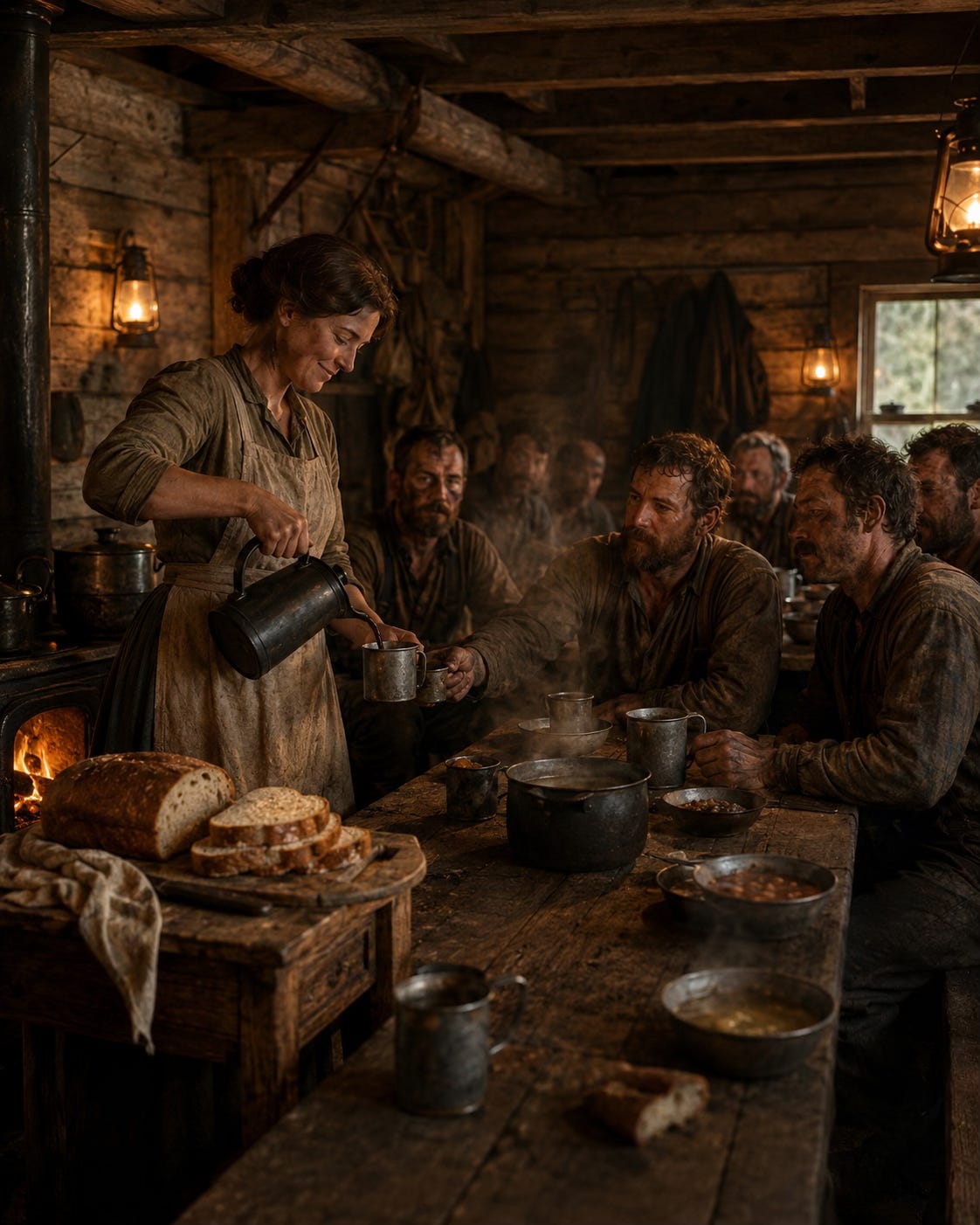
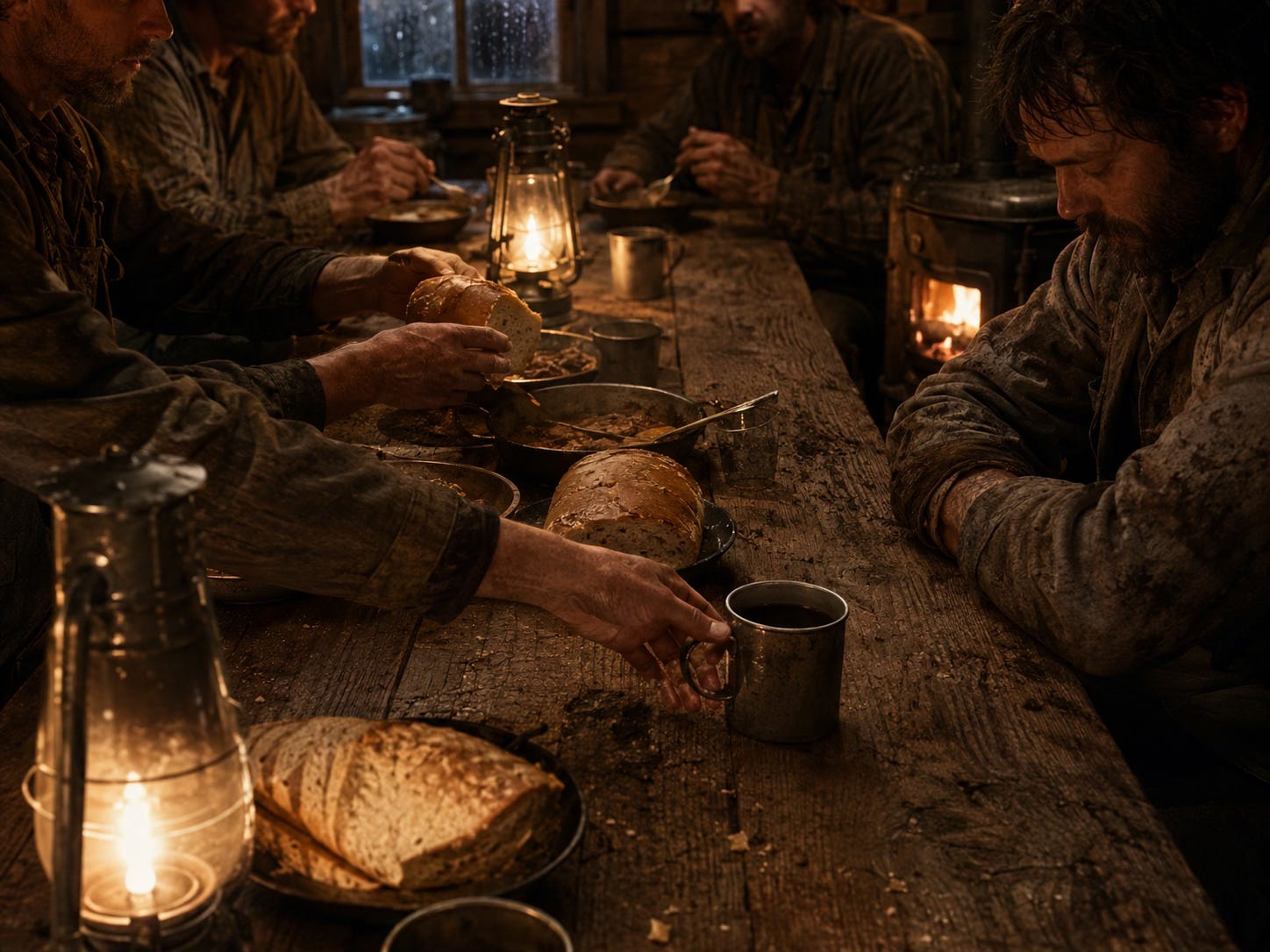
Tin cups knocked against rough plank tables.
Coffee steamed in the lanternlight.
Bread passed from hand to hand.
Someone laughed too loudly.
Someone else said nothing at all.
Someone looked once toward Hank’s bowl and then looked away.
At the end of one table, the bowl kept its quiet place.
That bowl said what no sermon could say.
A man had been here.
A man was missed.
A man’s absence still belonged to the room.
That was the thing about the Dining Hall.
It was never just a place to eat.
It was where the camp had to look at itself.
Before Timberline had a schoolhouse that meant anything, before the church bell could gather a grieving camp, before the rail spur proved whether the company would live or die, the Dining Hall did the first hard work of community.
It put people at the same table.
It made rank sit down.
It made grief visible.
Not because the men agreed.
Not because they were the same.
Not because every person had equal power when they walked through the door.
They did not.
Elias Everett owned the camp. Jack Mercer commanded in the cut. Cal Everett counted loads, payroll, deadlines, rail ties, and the cost of every delay.
Maggie ruled the kitchen with a ladle, a sharp tongue, and the authority of a woman who understood that hungry men became foolish men if nobody fed them first.
Emma Everett entered that room as the schoolteacher.
Sam Mercer entered it as a logger.
Greenhorns entered it hoping no one noticed how much fear they still carried in their hands.
But hunger has a way of humbling rank.
Around those tables, a boss still had to hear the scrape of bowls.
Around those tables, an owner still had to see the faces attached to the numbers in his ledger.
Around those tables, a proud man still had to sit close enough for someone to notice if his hand shook when he reached for his cup.
That is where community begins.
Not in speeches.
Not in slogans.
Not in everyone pretending the hurt is smaller than it is.
Community begins when people sit close enough to become responsible for one another.
That may sound simple.
It is not.
We live in a time with more ways to talk than any generation before us.
We can speak instantly.
We can react instantly.
We can judge instantly.
We can leave instantly.
We can disappear instantly.
We can build whole versions of ourselves without ever sitting across from someone who knows when we are not all right.
But a table is different.
A table slows people down.
A table gives the body back to the argument.
At a table, you cannot become only an opinion.
At a table, you are also a tired face.
At a table, you are a cold hand around a cup, a person who may need another piece of bread.
That was the hidden power of Timberline’s Dining Hall.
It made people visible.
A man could hide pain on the saw line.
A man could say his shoulder was fine.
A man could laugh off fear and keep walking because the trees did not ask gentle questions.
But at supper, someone noticed.
Someone saw the bowl left untouched.
Someone heard the silence where a joke should have been.
Someone watched a greenhorn sit too straight, trying to prove he was not scared.
The woods taught men to watch trees.
The Dining Hall taught them to watch each other.
And that mattered.
Timberline was not held together by timber alone.
It was held together by people returning to the same room after hard things had happened.
Accidents.
Arguments.
Pressure.
Debt.
Grief.
Fear.
The Dining Hall was not sacred because no one disagreed.
The Dining Hall was not peaceful because no one carried anger.
The Dining Hall mattered because people disagreed and still passed the bread.
That is why this room stays with me.
Not because it was perfect.
Not because everyone in it knew how to speak gently.
Not because grief behaved itself once coffee was poured.
It was full of tired people, proud people, grieving people, stubborn people, frightened people, and people who did not always know how to say what they were carrying.
Maybe that is why it feels honest.
A perfect table would not help us much.
A faithful one might.
We talk now about rebuilding trust, restoring community, healing divisions, and finding common ground.
Those are good words.
But bridges are hard things.
A bridge asks someone to cross toward another person.
A bridge asks for trust from people who may already feel betrayed.
A bridge asks for courage from people who may already feel exhausted, unseen, or unsafe.
And I wonder if sometimes we ask for the crossing before we have offered the bread.
Hungry people do not listen well.
Cold people do not trust easily.
Grieving people cannot be lectured back into strength.
Lonely people do not need a slogan first.
Tired people do not need to be corrected before they are seen.
Wounded people do not need a bridge before they have a chair.
They need a place.
They need warmth.
They need to be remembered before they are corrected.
They need someone to say, “Sit down. Eat first.”
In Emma Everett’s world, the lesson became plain:
Bread before bridges.
You feed people before you ask them to cross hard ground.
You make a place at the table before you ask someone to belong.
You let the room warm before you ask for truth.
That is not weakness.
That is wisdom.
And it is easy to miss.
It is easy to underestimate the people who keep a community alive in ordinary ways.
The ones who make coffee.
The ones who save chairs.
The ones who notice who has gone quiet.
The ones who remember the person everyone else is afraid to mention.
The ones who stay after the hard words.
The ones who clear the bowls.
The ones who come back tomorrow and do it again.
Communities do not survive on slogans.
Communities do not survive on clever arguments alone.
Communities do not survive when every table becomes a battlefield and every silence becomes an exit.
They survive on repeated acts of presence.
They survive because someone makes coffee.
They survive because someone opens the door.
They survive because someone cuts the bread.
They survive because someone says the missing man’s name.
They survive because someone looks across the table and notices another human being trying very hard not to break.
That kind of work rarely gets applause.
But it holds the world together.
In Timberline, Maggie’s work was not small because it happened in a kitchen.
In Timberline, Emma’s work was not small because she spoke softly.
In Timberline, Sam’s kindness was not small because it did not announce itself.
And Jack’s strength was not only in the woods. It was in his willingness to sit among the men afterward and face the cost of what command required.
Maybe that is what we are missing more than we know.
Not just agreement.
Not just better arguments.
Not just louder certainty.
Maybe we are missing tables.
Faithful ones.
Imperfect ones.
Tables where tired people are not required to perform strength before they are allowed to be fed.
Tables where quiet people can speak without being swallowed.
Tables where leaders sit close enough to the cost of their decisions.
Tables where absence is not rushed away.
Tables where grief has a chair.
Tables where someone still passes the bread.
And maybe that is the question the Dining Hall leaves on the table for us:
Who have you offered bread and coffee to today?
Not as a performance.
Not because anyone was watching.
Not because it would solve everything.
Just because someone near you was cold, tired, grieving, lonely, ashamed, afraid, or trying very hard to look fine.
Maybe it was coffee.
Maybe it was a text.
Maybe it was a chair pulled out.
Maybe it was a meal left on a porch.
Maybe it was five honest minutes with someone who needed to be heard.
Maybe it was saying the name everyone else was afraid to say.
Maybe it was forgiving someone enough to sit near them again.
Maybe it was letting someone be tired without asking them to explain the whole weight of it.
Because some tables do more than feed us.
Because some rooms do more than shelter us.
Because some ordinary acts hold back more loneliness than we know.
Some tables teach us how to belong.
Some bowls teach us how to remember.
Some cups of coffee teach us how community begins again.
And sometimes community begins again when someone says, simply:
Sit down.
Eat first.
I made coffee.
Building community can be as important today as it was in 1892!
If you know someone who might benefit from Timberline, please use the link below to do your part today.
If you are still reading ot listening at this point in this article, I would love to hear from you. Tell me anything. I just appreciate you that much!
I love Maggie. So much. 'Hungry people do not listen well. Cold people do not trust easily. Grieving people cannot be lectured back into strength." will be in my head for a few days.