
The Mountain Gets a Say
Timberline cuts timber, lays rail, and keeps ledgers. Tahoma keeps the larger account.

The Warning
Jack Mercer changed the day’s work before the men had finished breakfast.
That was how Timberline knew the Mountain had spoken.
Not in words. The Mountain had no need of words, and men had proved too fond of arguing.
But cloud on a mountain shoulder was harder to dismiss.
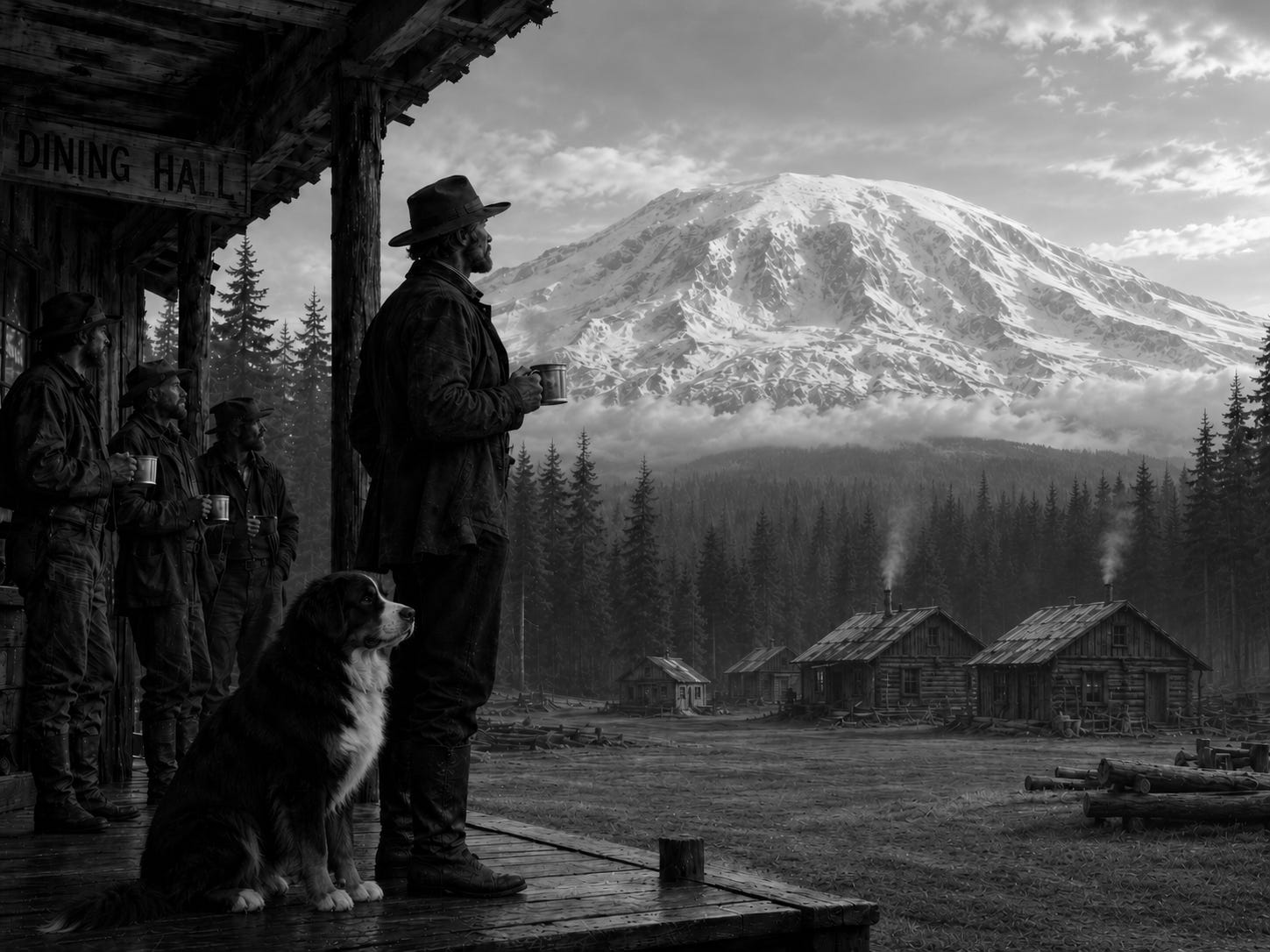
The men came out under clean gray light, coffee doing what it could. Henry Harper stood near the Dining Hall porch, one suspender twisted. All of them looked east.
Adam Two Cedars had seen it. Lena Whitefeather watched without speaking. Neither needed Timberline to name a warning to recognize one.
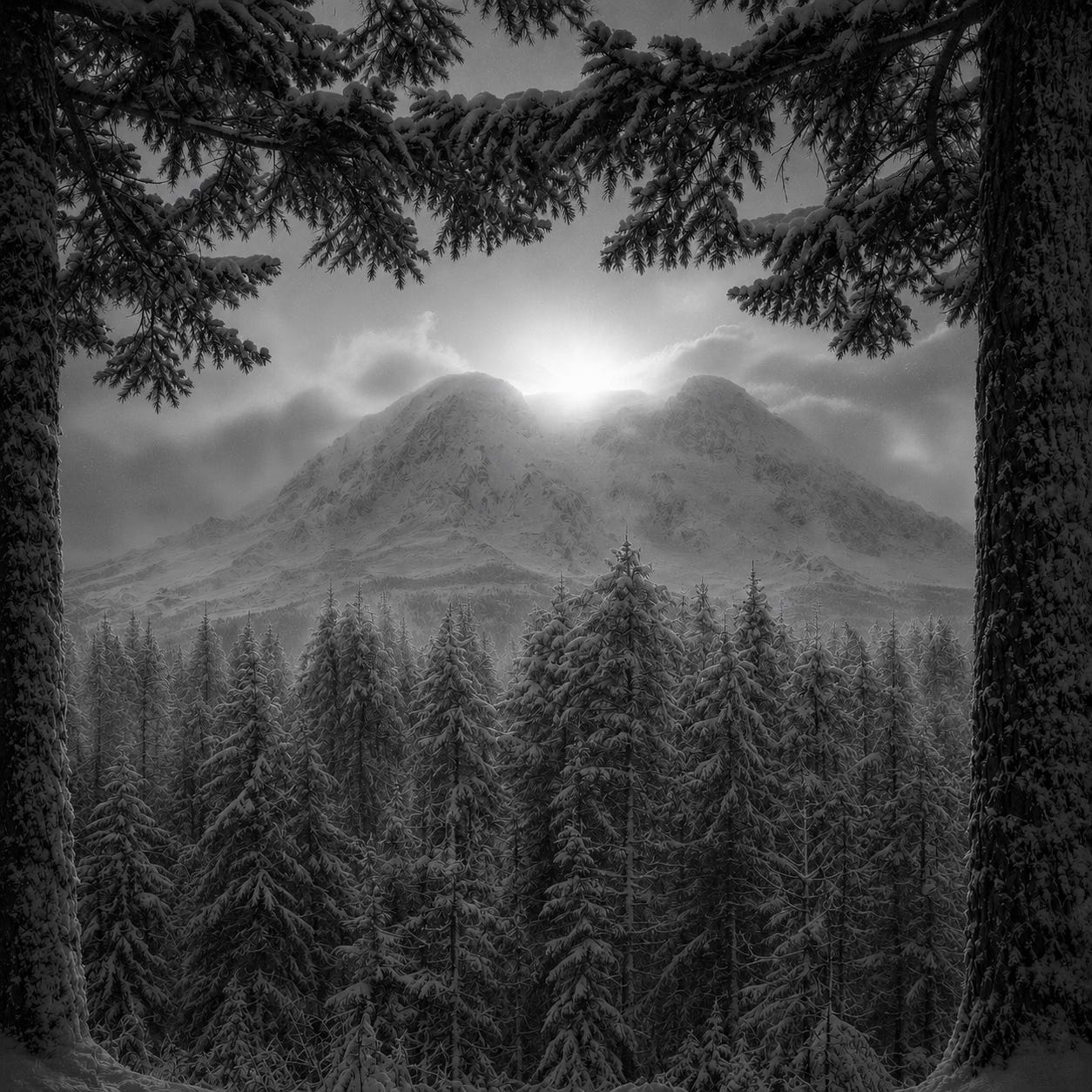
Tahoma had not vanished. The summit showed itself in pieces — white crown clear, lower shoulders swallowed, dark cloud pulling across the shoulders like a warning drawn tight.
Even Rusty sat still.
In Timberline, that counted.
Henry shifted his jaw. “Ridge’ll be wet before noon.”
“Before that,” Jack said.
Sam Mercer looked from the Mountain to the crews gathering near the landing. “That cloud’s coming down with its sleeves rolled.”
Jack nodded once. “No high cutting today. Keep the crews lower. Check footing twice. No man works above soft ground.”
A few men glanced toward the sky as if hoping for a second opinion.
Tahoma offered none.
From the Dining Hall doorway, Maggie O’Donnell lifted the coffeepot. “If the Mountain’s finished running the meeting, plates still need washing.”
That broke the spell enough for men to move.
Not enough for them to forget.
By noon, rain had silvered the high firs. By two, brown water ran in the upper road’s wheel ruts. By supper, the men who might have been above it sat in the Dining Hall with wet cuffs, full bowls, and the careful silence of a warning answered in time.
No one called it luck.
Not where Jack could hear.
The Mountain gets a say.
This begins a four-part dispatch on the powers that shape Timberline: Tahoma, the Ridge, the Forest, and the River.
Tahoma comes first.
To understand Timberline, do not start with the mill, the rail spur, or the ledger. Start by looking up. Before the mud, a man notices the Mountain.
Not near. Not small. Not decorative.
Why Tahoma
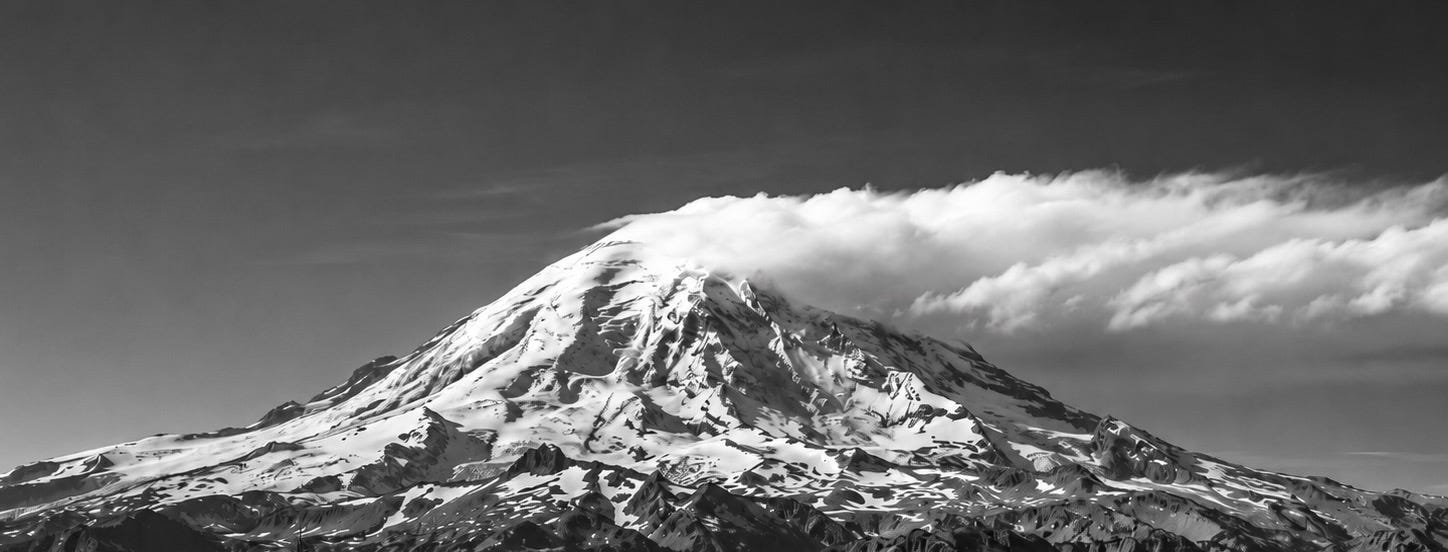
On most maps today, the peak is called Mount Rainier, a name Captain George Vancouver gave in 1792 for Rear Admiral Peter Rainier, who never saw the mountain himself.
But the Mountain was known long before it reached British maps. Tahoma, Tacoma, Takhoma, and related forms belong to Indigenous-language traditions of this region. Spellings, meanings, and usage vary by language and community.
That is why I call it Tahoma: not to pretend Timberline owns the name, but to remember that the Mountain was already known.
The First Readers
I will not pretend to explain all that Tahoma means to the Nisqually and to the other Native peoples connected to the Mountain. That is not mine to flatten into a paragraph.
But Timberline is late to a lesson this land had been giving for a very long time.
Long before Jack Mercer read cloud on Tahoma’s shoulder, the peoples whose homelands surround the Mountain watched it for weather, water, season, and warning.
Not as scenery. Not as ornament. As presence.
Jack reads Tahoma as a foreman responsible for men on a saw. Lena reads it with the memory that the Mountain was speaking before Timberline had a name.
Those are not opposing truths. They are different depths of listening.
Weather Becomes Water
A camp like Timberline lives by immediate things: the next cut, the next meal, the next storm, the next train, the next debt coming due.
Men working close to danger can mistake the next step for the whole world.
Tahoma corrects that error without moving an inch.
Some mornings it rises clear and white above the firs. Other mornings, cloud and mist take it from sight, and men say, “Weather’s thinking.”
Jack looks for the Mountain the way some men check a watch. Clear peak tells one story. Hidden summit, low cloud, damp wind tells another.
Either way, he listens.
Tahoma governs more than mood. It governs water.
Rain on the shoulder becomes seep under a skid road. Low cloud becomes slick roots and a hill that will not forgive a careless boot. A bright peak can become mud underfoot by afternoon and a hard-running River by morning.
Men here cut timber, haul logs, load cars, sharpen saws, set chokers, keep ledgers, and bury the dead.
They try not to let pride do their thinking.
Even Elias Everett does not own the terms of weather.
Tahoma keeps the larger account.
When Men Forget Their Size
Tahoma is not a backdrop.
It is the white crown over hard work, the far line that still feels near, the silence above every hammer strike, saw pull, argument, and promise made under pressure.
By supper, no man called Jack’s morning order luck.
Not with rain on the high firs. Not with brown water in the upper road’s wheel ruts. Not with Tahoma hidden behind cloud, having already said what needed saying.
Around here, when men forget their size, Tahoma remembers.
— Jay Allen Ford
Next Dispatch: The Ridge
Where every step has memory, and every cut depends on what the ground will hold.
On a personal note, some of my earliest memories are waking up with my father to have him tell me the day’s weather based on the mountain.
If you enjoyed this post, please share it with others to spread the word.
Beautiful and you have caught the size of man compared to the mountain. I totally enjoyed.
What a compelling story.It’s interesting how the Mountain’s warning brings the community together, even in silence.