
The Last Dry Log
Subtitle: A Timberline Fireside story about care, responsibility, and disagreement without enemies

The Last Dry Log
By the sixth night of rain, Timberline had three pieces of seasoned fir left.
The camp was not short of trees. Douglas-fir stood by the thousands beyond the dining-hall windows, and windfall choked half the roads. But green wood hissed, smoked, and spent its first heat drying itself.
What Timberline lacked was wood that would burn now.
Pete crouched before the cast-iron stove, watching a damp split struggle above the coals.
Rain hammered the roof. Water poured from the eaves and ran black between the buildings. The River had climbed past the lower stones before supper. The Mountain had been gone behind the weather for three days.
“Shut that door,” Maggie said. “You’re warming the stovepipe.”
Pete pushed the split deeper and closed the iron door.
Jack looked toward the wood box.
One dry piece for the evening.
One to hold coals through the night.
One to wake the green wood in the morning.
Before dawn, men would close cold hands around ax handles and saw grips. A numb hand seated a wedge badly. A stiff leg stole the first step when a tree began to turn.
The dining-hall door flew open.
Rusk stood in the doorway, rain streaming from his hat and coat.
“Jack.”
Something in his voice brought Jack to his feet.
“What is it?”
“Man down by the washhouse.”
Rusk was back in the rain before Jack reached the door.
They crossed the yard at a run. The lantern in Rusk’s hand swung over mud, wagon ruts, and rushing runoff.
Jack nearly missed the hand beside the path.
A man lay facedown, one arm trapped beneath him, the other buried to the wrist in mud. His coat had twisted around his legs. One boot was gone.
Rusk dropped beside him.
“Breathing.”
Jack found a faint pulse in the man’s neck.
“Cal!” he shouted toward the dining hall. “Blankets!”
Rusk slid an arm beneath the stranger’s shoulders.
“Take his legs.”
Together they lifted him.
Mud filled his hair and covered one side of his face. Water streamed from his clothes. The River clung to him in smell and cold.
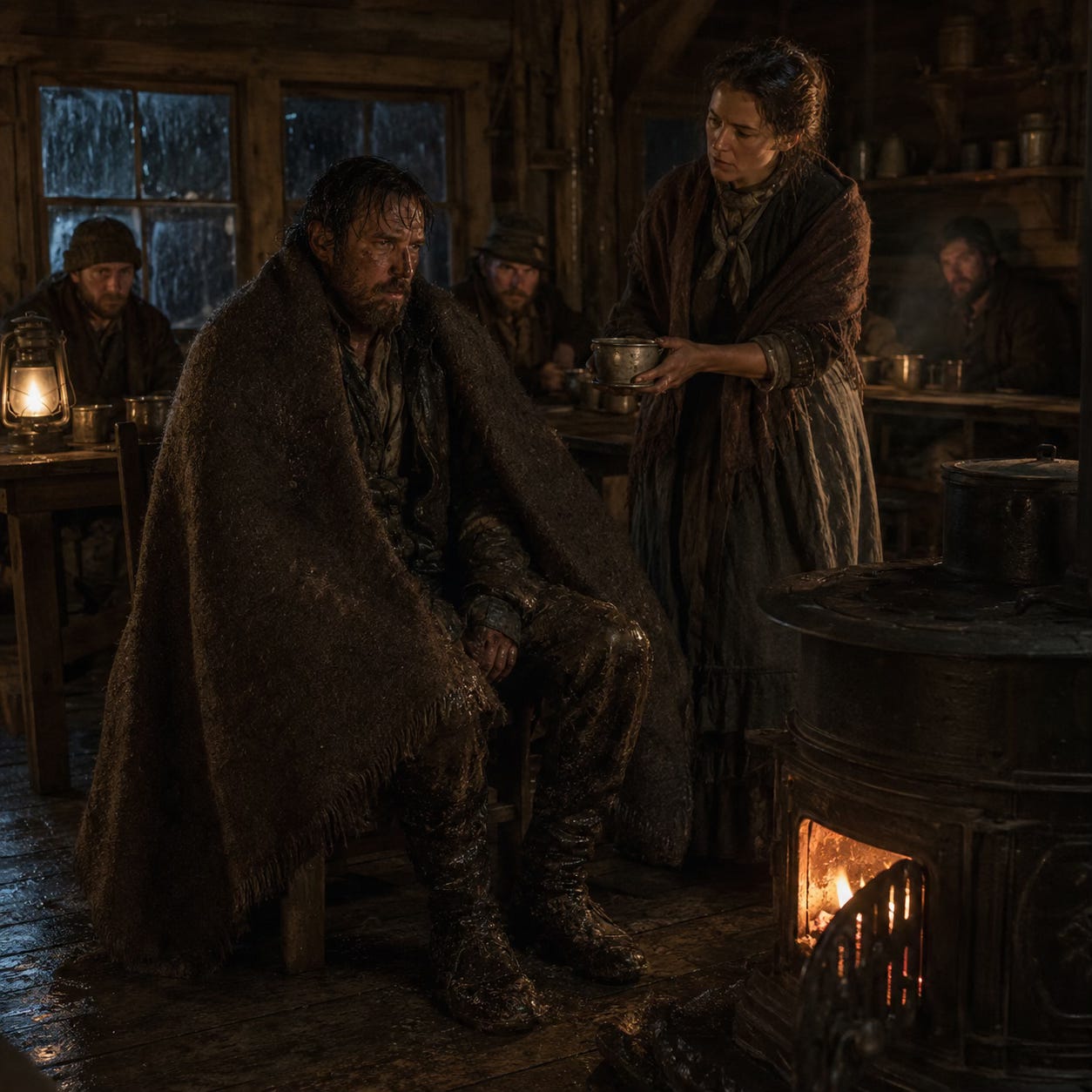
Cal and Pete were waiting when they reached the hall.
They laid the man beside the stove.
Maggie came with blankets.
“Get those wet clothes off him.”
“He’s covered in mud,” Pete said.
“He’s freezing first and dirty second.”
Jack and Cal pulled away the man’s coat and soaked outer clothes while Maggie cleared the mud from his mouth and nose. Beneath it, his skin was gray.
“I need warm water,” she said. “Enough to see what else the River did.”
Pete looked toward the wood box.
Three pieces.
Rusk looked too.
“We can warm him without washing all of him.”
“Mud in a wound becomes fever.”
“We don’t know there’s a wound.”
“That’s why I need enough off to find out.”
Rusk removed his dripping hat.
“My children slept in their coats last night.”
Jack knew.
Rusk had spent the afternoon patching his cabin roof. His youngest girl had been coughing for two days. At breakfast, all three children had crowded close enough to their little stove that their shoulders touched.
“If the lower road holds, Cal can take him to Eatonville tomorrow,” Maggie said. “I won’t send him wearing half the River.”
“And if the road washes out?”
“Then he stays.”
“One man comes out of the rain,” Rusk said, “and now we feed him, heat him, wash him, and carry him to town.”
“Yes.”
“That wood belongs to the camp.”
“So does the responsibility.”
Jack raised one hand.
“That’s enough.”
The stranger shuddered beneath the blankets. His teeth struck together, though his eyes remained closed.
Jack crossed to the wood box.
He lifted one seasoned piece and put it in the stove.
“Heat the water.”
Rusk stared at the two pieces left behind.
“And morning?”
“We’ll meet morning when it comes.”
“That’s easy to say from a dry cabin.”
The room went still.
A hard answer rose in Jack’s throat.
He let it die there.
“You’re right.”
Rusk’s jaw loosened a fraction.
“My roof holds,” Jack said. “Yours doesn’t. I’m spending wood your family may need.”
“But you’re spending it anyway.”
“Yes.”
“I still think it’s too much.”
“I know.”
Maggie lifted the iron kettle.
Rusk stepped forward and took the heavier handle.
“I didn’t say to spill it.”
Together they set the water over the heat.
When it warmed, Jack, Cal, and Olav carried the stranger behind the canvas screen near the kitchen. Maggie passed them cloths and a basin.
They kept him covered and cleaned only what they needed to inspect. Beneath the mud, they found bruised ribs, a cut above one eye, and a deep scrape along his shin.
Nothing appeared broken.
The man woke while Jack cleaned his temple.
His eyes opened wide. He struck weakly at Jack’s arm.
“Easy.”
The blanket slipped from one shoulder. The stranger caught it quickly.
“You’re in Timberline,” Jack said. “Rusk found you outside.”
The man looked at the basin of brown water.
“My clothes.”
“Drying.”
“My boot?”
“Gone.”
His eyes closed.
“Everything was in it.”
“What was?”
“My money.”
“How much?”
“Enough to get home.”
Jack waited.
The man turned his face toward the canvas.
From beyond it, Maggie called, “Stew’s ready.”
He opened his eyes again.
“I can work.”
The words came too quickly.
“You can eat first.”
“I’m not asking charity.”
“No,” Jack said. “You haven’t asked for anything.”
Olav returned with a dry shirt and trousers.
“Borrowed,” he said. “Return them when yours are dry.”
The stranger’s grip loosened on the blanket.
“All right.”
They left him to dress.
When he emerged, Emma had placed a chair beside the stove. She stood behind it with one hand resting on the back.
“That place is yours.”
He sat.
Maggie brought him a full bowl of stew and bread.
His name was Amos Bell.
He had lost his job at a mill upriver and was walking toward Eatonville when the road shoulder gave way beneath him. The current carried him far enough that he no longer knew where he had climbed out.
He remembered seeing a light.
He did not remember reaching it.
“Someone waiting for you in Eatonville?” Jack asked.
Amos stopped with the spoon halfway to his mouth.
“My girl.”
“How old?”
“Seven.”
He looked toward the empty place where his boot should have been.
“I told her I’d come.”
The new log shifted in the stove. Fire moved along the split grain, its light trembling in the basin of muddy water.
Amos looked toward the far table.
“Thank you.”
Rusk held both hands around his cup.
“You were facedown. Didn’t seem a useful place to leave you.”
A few men smiled.
Amos lowered his eyes to the bowl.
“I’ll repay what I use.”
“Start by eating it hot,” Maggie said.
Pete found spare socks. Olav returned from the bunkhouse with a pair of used boots near enough to fit.
When Maggie needed the kettle moved, Rusk carried it. When Amos’s coat went onto the drying rail, Rusk shifted it nearer the stove.
After his second bowl, Amos looked toward the fire.
“What can I do?”
Maggie handed him a bundle of damp cedar strips.
“Keep these turning. We’ll need them by morning.”
Amos drew his chair closer and laid the first strips along the warm edge of the stove.
Near midnight, Jack placed the second seasoned piece into the fire.
One remained.
Amos still sat beside the stove, turning the cedar one strip at a time.
Jack lifted the final log, tucked it beneath his coat, and stepped into the rain.
Rusk followed him across the yard.
“Where are you taking that?”
“Your cabin.”
Rusk stopped.
“No.”
“Your girl’s coughing.”
“And the morning crew needs coals.”
“I’ll open the repair shed before dawn.”
“You’ll burn dressed timber worth ten times that log.”
“I know.”
Rusk stepped in front of him.
“You don’t settle every disagreement by taking the whole cost onto yourself.”
Jack looked down at the wood beneath his arm.
“No.”
“You made the call. Camp wood paid for the water.”
“Yes.”
“Then let it be the camp’s decision. Not your private punishment.”
Rain ran from Jack’s hat brim.
Rusk stood squarely in the path, his jaw still set.
From the family cabins came the faint sound of a child coughing.
Once.
Then again.
“What do you suggest?” Jack asked.
“Split it.”
“One half won’t last in either place.”
“It’ll last longer than pride.”
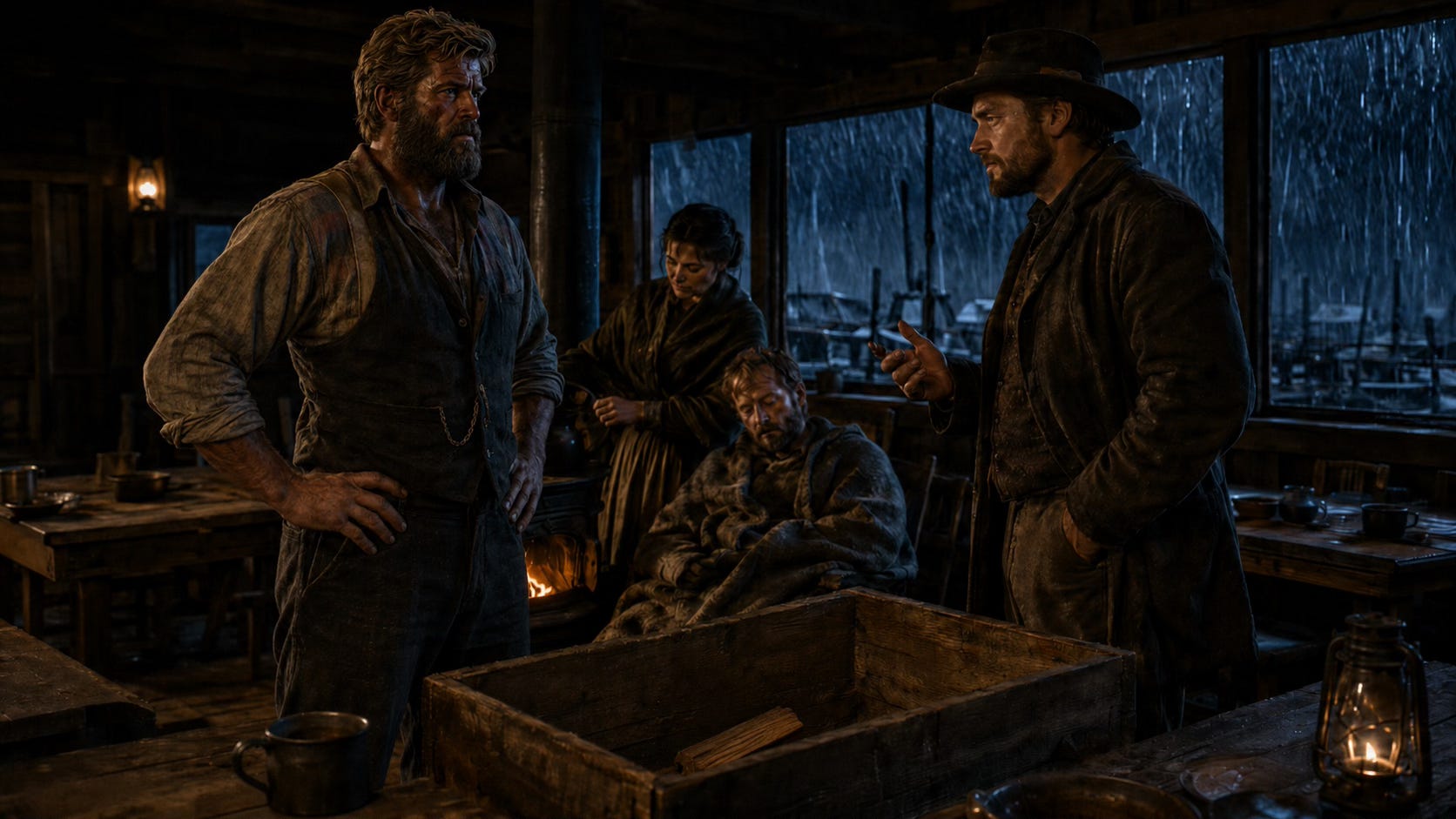
They carried the log beneath the chopping-block roof.
Jack set it upright.
Rusk raised the ax.
The first blow bit deep.
The second opened the grain cleanly.
Rusk lifted one half.
Jack took the other.
At the fork in the path, they stopped.
“I still think you spent too much,” Rusk said.
“I know.”
“You mean to hold that against me?”
“No.”
Rusk nodded.
“Good.”
“You?”
“Do it twice and I’ll tell you twice.”
Jack almost smiled.
“Fair.”
Rusk carried his half toward the family cabins.
Jack carried his toward the dining hall.
Through the rain-blurred window, Amos sat beside the stove, turning the damp cedar one strip at a time.
By dawn, smoke rose from both chimneys.
What do you believe belonging should offer—and what should it ask of us in return?
After the Fire: What Belonging Asks of Us
The Last Dry Log began with a question I have been carrying for some time:
What does it mean to belong somewhere?
Not merely to be welcomed.
Not merely to receive warmth, encouragement, or a place at the table.
What does belonging ask of us in return?
At Timberline, Amos is cared for before anyone asks what he can contribute. He is pulled from the mud, washed, clothed, fed, and given a chair beside the stove.
He does not have to prove his usefulness before receiving kindness.
Care offered only after someone proves their value is not freely given. A person who is injured, frightened, exhausted, or overwhelmed may have nothing to offer in that moment except the courage to accept help.
But once Amos is warm, fed, and steady enough, he asks:
“What can I do?”
Maggie does not hand him a debt.
She hands him damp cedar.
No one counts the strips or measures his work against the food, clothing, and fire Timberline has given him. The cedar is not payment for his supper.
It is a place in the work.
That is the kind of community I want Timberline to represent—and the kind I hope we are building around these stories.
We will care for one another without first demanding proof of usefulness.
We will sit beside people when the road becomes difficult.
We will help carry someone who cannot yet carry themselves.
But good care should restore strength and dignity. It should not quietly teach a person that they have nothing left to offer—or that every difficult step will always be taken for them.
There may be seasons when someone carries very little because little is all they have.
That does not make their contribution meaningless.
One person may lift the log.
Another may tend the fire.
Another may notice the hand in the mud that everyone else nearly passed.
The work will not always look the same. The weight will not always be equal.
Belonging does not require equal strength.
It asks for willingness.
No one should be expected to carry what they cannot.
No one who is able should leave all the carrying to others.
The story also asks what happens when good people disagree.
Rusk is not cruel. He is not selfish. His children are cold, his daughter is coughing, and the camp is burning seasoned wood his family may need.
Jack does not shame him for saying so.
Rusk does not turn Jack into an enemy because Jack makes a different decision.
Neither man has to surrender his convictions in order to remain part of Timberline.
They speak plainly. They remain in disagreement. Then they split the final log and share what follows.
That may be one of Timberline’s most important principles:
Agreement is not the price of belonging.
A person should be able to question a decision without being branded disloyal.
A leader should be able to hear an objection without treating it as an attack.
Friends should be able to disagree without saving the moment as a weapon for later.
We do not have to think alike to remain at the same table.
We do have to treat one another with dignity.
We have to listen long enough to understand what the other person is trying to protect.
And when a decision has been made, we must decide whether we are still willing to help carry its consequences together.
The obligations of belonging do not end with the people gathered around the stove.
They extend to the ground beneath the camp and the water running past it.
Timberline draws its living from the forest and the River. That use carries responsibility.
The land may be worked, but it should not be used up.
Those who cut must leave enough for the next forest. Those who build roads must keep soil from bleeding into the water. Those who fish must protect the runs. Those who benefit from the River must remember that every careless choice travels downstream.
A ledger that records only what was taken is not an honest ledger.
It must also account for what was damaged, what was restored, and what was left standing.
Timberline does not stand upon empty ground.
The Nisqually people’s relationship with the River, the fish, the forests, and the surrounding land began long before the camp. They do not need Timberline’s permission to belong there.
Their knowledge cannot be treated as advice accepted only when convenient. Their voices cannot be invited only after the decisions have already been made. Places of meaning cannot be protected only when protection costs nothing.
Shared use requires shared voice.
Reciprocity is not one party announcing, “We will share what we have decided is ours.”
It begins with the recognition that everyone who receives from the land accepts obligations toward its continued life—and toward the other people who depend upon it.
Those who cut must protect what will grow next.
Those who draw from the River must help keep it living.
Those who benefit from a community must help sustain it.
The same truth runs through all of Timberline:
Care should not humiliate.
Responsibility should not become cruelty.
Disagreement should not create enemies.
What we use, receive, and belong to should be left stronger by our presence.
Timberline will not promise to do everything for you.
It will not leave you to do everything alone.
There is room at the table.
There is a chair beside the fire.
There is a place in the work.
And when your hands are steady again, there will be damp cedar waiting for you to tend.
I love the way you write dialogue (and can kind of see where/why you would critique my loquaciousness).
In the economy of your words in this piece, you convey practical emergency reactions, evaluating the patient and making quick work of prioritizing his needs quickly. I hope he is as honest and earnest as he is portrayed. The job and land itself are dangerous enough. The first boy I dated as a teen has a traumatic brain injury and other permanent issues from having a tree go wrong while he was felling it (he was a pro). Back in the time this is set, when there wasn’t life flight and trauma centers, injuries were a lot more grave.
We have been doing something a lot less organized at the Porch (so called because in good weather it starts on my porch swing). I can’t wait to see what you’re building.
Dear Jay,
The scene that stays with me isn't the rescue. It's the splitting of that last log. Rusk never agrees with Jack. Not once. "I still think you spent too much." "I know." That's the entire resolution, and it's enough, because nothing in this story asks disagreement to end before people can stand next to each other again.
That's a different mechanism than most stories about community use. Usually belonging gets secured by consensus, or by one person conceding they were wrong. Here it's secured by two people carrying opposite convictions into the same swing of the ax.
Amos runs the same logic in reverse. Nobody asks him to prove anything before the blanket, the stew, the chair by the stove. So when he finally offers, "what can I do," it isn't obligation talking. It's something that was allowed to arrive on its own time, which is the only way an offer means anything at all.