
The Ridge Keeps Count
Tahoma warns from above. The Ridge answers underfoot.

The Ground Answered Wrong
Jack Mercer stopped the crew because the ground answered wrong.
Not loud.
That was the trouble with it.
A tree would crack. A rope would sing. A startled horse would throw its head and tell every man with eyes that something had gone sideways.
The Ridge was quieter than that.
It spoke through a boot sinking half an inch too deep. Through water shining black beneath fern roots. Through a cedar leaning a little harder than it had the evening before.
Jack felt it under his corks and stopped.
Behind him, two sawyers shifted the crosscut on their shoulders. Henry Harper came up breathing steady, peavey in hand. Pete Hawkins stood three steps below, trying to look like he understood what had just happened.
He had been watching the tree.
Jack was watching the ground.
Sam Mercer followed Jack’s gaze.
The slope did not look dangerous to a greenhorn.
That was another danger.
The sidehill showed green, wet, and ordinary. Sword ferns drooped under last night’s rain. Moss shone on the roots. A thin run of water moved where no run of water had been the day before.
Jack crouched and pressed his fingers into the duff.
It held.
Then gave.
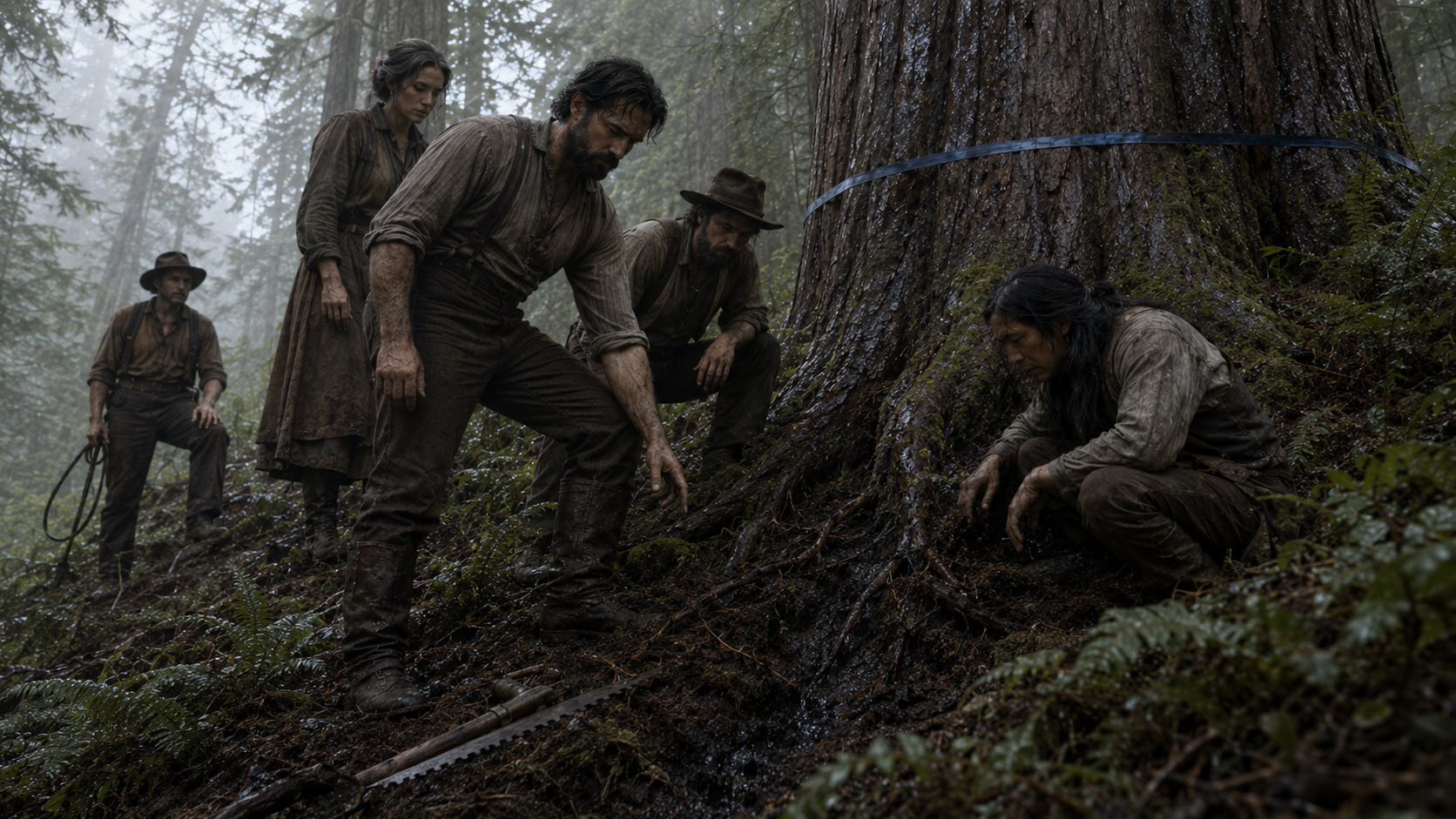
Adam Two Cedars looked past Jack to the fir above them. Not at the crown. Not at the trunk. At the roots.
One root had lifted clean enough to show a dark seam beneath it.
“Water’s crossing,” Adam said, “not dropping.”
Lena Whitefeather stood higher on the game trail, watching the same slope from another angle. She pointed to where the faint deer path bent wide around the wet ground.
“Even they went around,” she said.
Sam’s eyes moved from the deer trail to the root plate, then down the fall line.
“Road’s soft under the skin.”
Jack nodded once.
Henry looked upslope, then at the tree. “We can still take the lower cedar.”
“No high cutting,” Jack said. “Not here.”
A few men looked at the tree.
It was good timber. Straight. Tall. Worth the climb.
Pete looked at it too. Then he looked at Jack, waiting to learn which thing mattered more.
Jack stood.
“No man stands below a question.”
That settled it.
Not every man liked the decision. Men who come to work do not enjoy being told the ground has more sense than they do.
But they moved.
Jack sent the crew lower, marked the wet sidehill, and put two men on waterbars before any saw touched wood.
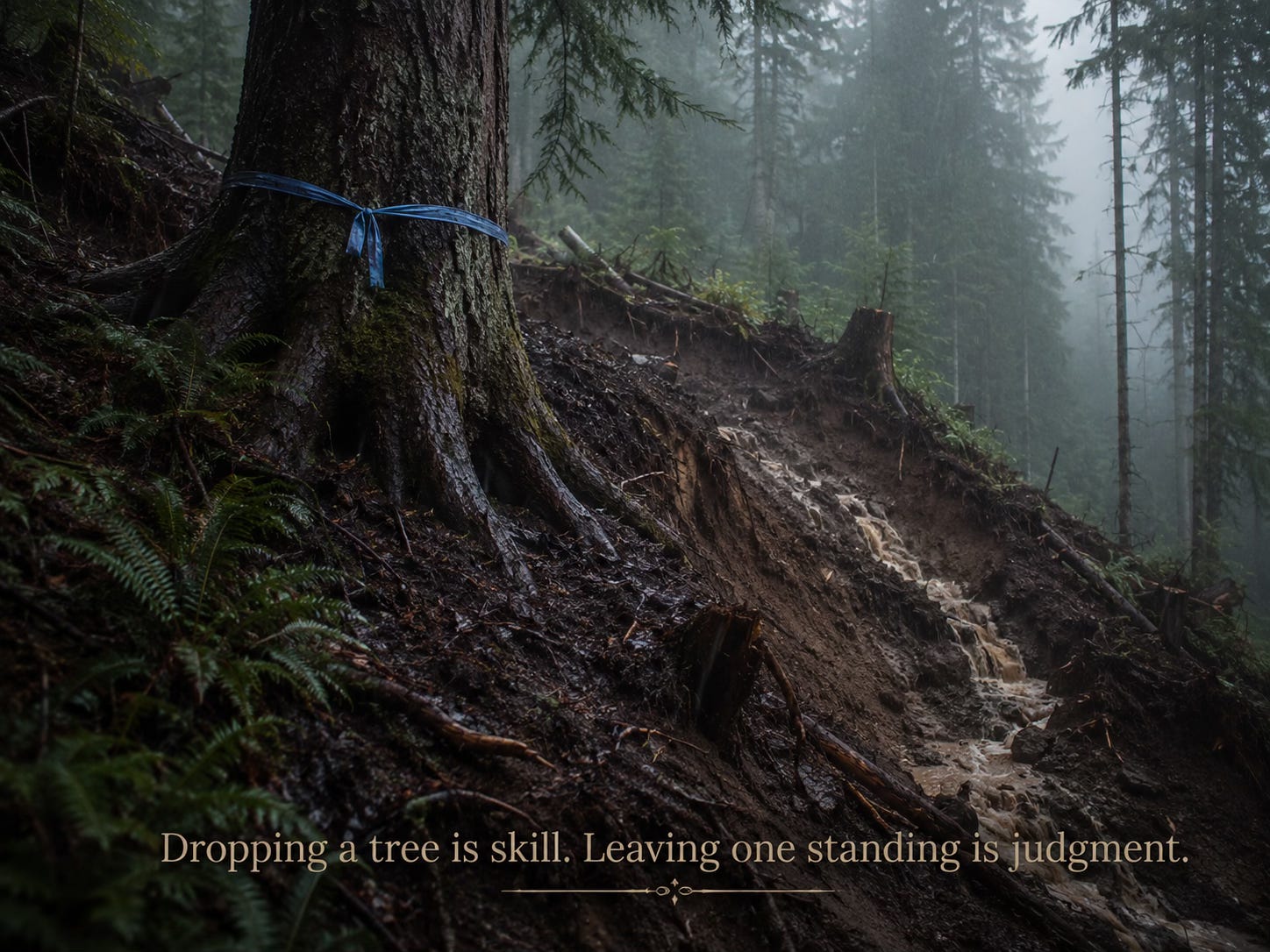
Adam tied blue ribbon near the cedar’s root flare.
At Timberline, blue meant leave it standing.
Jack looked at the ribbon, rain-dark against the bark, and heard his father’s voice as plainly as if Thomas Mercer stood beside him on the slope.
Dropping a tree is skill.
Leaving one standing is judgment.
Jack had learned that rule young.
He had needed years to understand how much of it was about men.
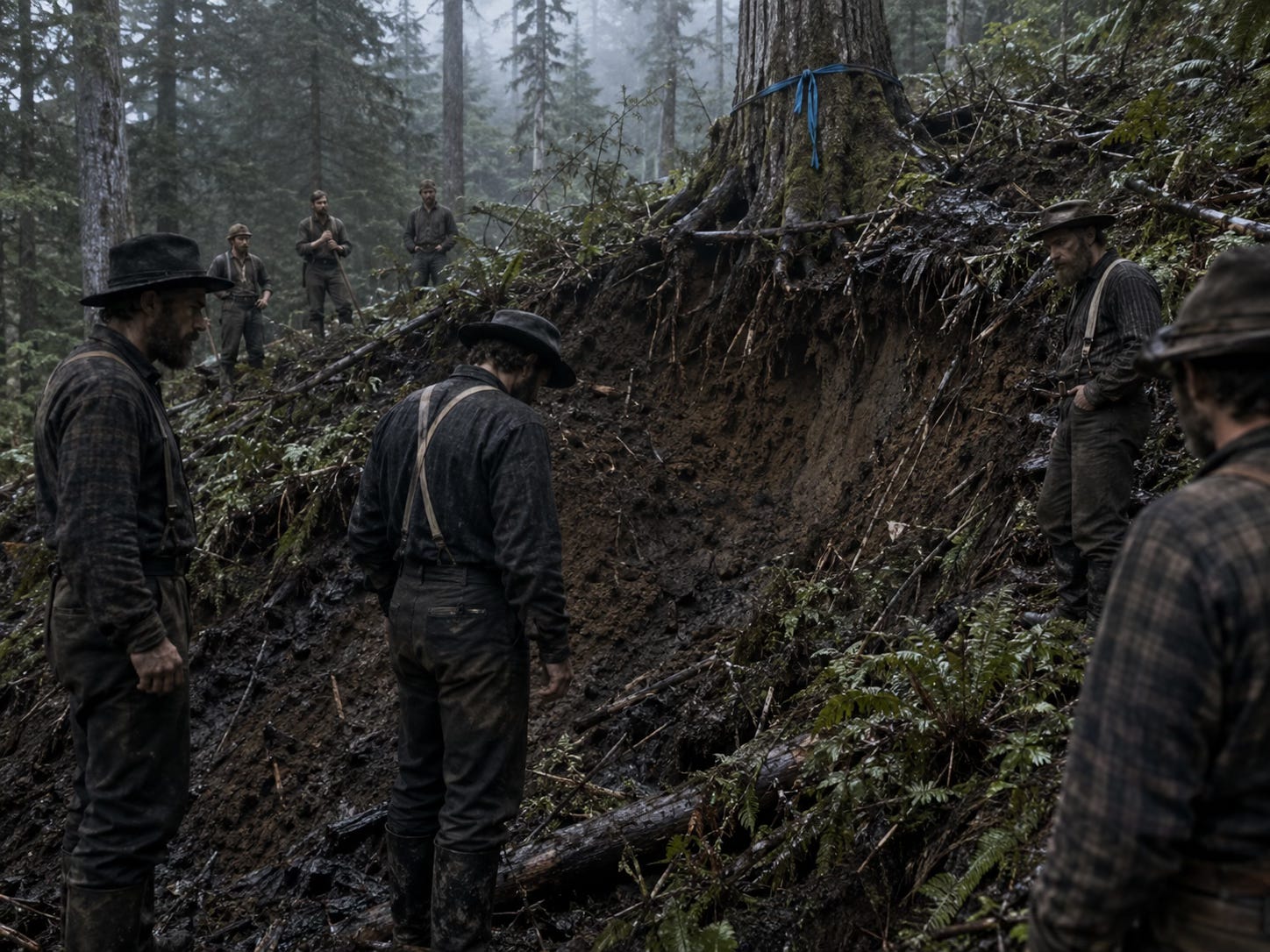
By noon, the dark seam had widened.
By two, the root plate tore loose with a sound like cloth ripping under a boot heel. A thin piece of hillside sloughed across the place where Pete Hawkins had wanted to stand with a choker in his hands.
Pete stopped at the edge of the raw earth and said nothing.
No one called it luck.
Not where Jack could hear.
That is one of the first things Timberline teaches about the Ridge: danger does not always announce itself from above.
Sometimes it waits underfoot.
Underfoot
This is the second Dispatch on the powers that shape Timberline: Tahoma above it, the Ridge beneath it, the Forest around it, and the River waiting below.
Tahoma tells men to look up.
The Ridge teaches them where to put their weight.
A visitor may see a ridge as a line on the horizon, a place where timber rises, or a fine position from which to admire the Mountain. A surveyor may see elevation, boundary, acreage, and grade. A banker may see value if someone has written the numbers clearly enough.
Timberline knows better.
The Ridge is not just high ground.
It is footing.
Fall line.
Drainage.
Escape road.
Runout.
Loose root.
Hidden spring.
The place a tree wants to go when gravity has finished listening to men.
A ridge holds more than timber. It holds memory.
Every skid scar left by a dragged log. Every rut cut too deep. Every old burn line under moss. Every stump that tells which way a man once stood and whether he knew what he was doing.
Men may forget.
Weather does not.
Ground does not.
Water certainly does not.
Reading the Sidehill
In Timberline, a man learns quickly that the Ridge is not scenery.
It is the floor of every decision.
Where to cut.
Where to stand.
Where to run.
Where to lay a skid road.
Where to leave a tree because its roots are holding back more hillside than any man has right to spend.
A bad cut on flat ground can kill a man.
A bad cut on the Ridge can kill the men below him too.
That is why Jack watches feet before faces.
A man can lie with his mouth. He can even lie with his confidence.
His boots tell more truth.
Pete Hawkins learned that the hard way. Every greenhorn does. He learned that the safest place is not always the place that looks farthest from the tree. He learned that escape roads are chosen before steel bites wood. He learned that downhill is not a direction so much as an invitation to be crushed.
Jack teaches it plain.
“Pick your road before you pick your fight.”
There are no late decisions on a sidehill.
Once timber starts moving, every lie told by the ground collects interest.
A root gives.
A boot slides.
A man reaches for a limb that cannot hold him.
A log rolls because a slope gave it leave.
Then everyone acts surprised, though the sidehill had been speaking all morning.
Jack reads the Ridge as a faller boss.
Adam Two Cedars reads it differently.
He watches where salal grows thick, where alder leans, where water chooses root instead of stone. He notices when deer trails avoid a place that men are eager to enter. He sees the old work of rain under moss and the kind of green that means the ground is hiding water.
Lena Whitefeather looks longer than most men are comfortable with.
Not because she is slow to decide.
Because she knows land does not answer faster for being hurried.
The Ridge carries old paths, hidden water, root-holds, skid scars, and the record of what men failed to see.
Timberline is still learning that kind of reading.
The camp arrived with axes, ledgers, wagons, rails, and hunger. It measured what it could sell first, because men under debt often mistake price for meaning.
But the ground had been keeping its own account long before the first ledger reached Timberline.
Adam knows that.
Lena knows it too.
Jack is learning.
That is one reason Timberline survives as long as it does.
Not because its men are fearless.
Because some of them are teachable.
Work on an Angle
A ridge decides where a camp can live.
Men may draw lines on paper, but the ground answers in grade, water, clay, stone, and root.
The road to the depot follows the easier shoulder because wagons have opinions about steepness. The rail spur takes the line men could force through timber, not necessarily the one they first wanted. Cabins sit where water does not claim the floor by morning. The Dining Hall stands where men can reach it tired, wet, hungry, and still mostly upright.
Even the plank walks tell the truth.
They are not decoration.
They are confession.
A plank walk says the mud won often enough that someone stopped arguing.
After rain, the Ridge changes the whole camp.
Boots come in heavier.
Horses breathe harder.
Harness straps darken.
Ax handles swell.
Men who laughed at caution in the morning speak lower by dusk.
Wet ground reduces speeches.
It does not care what a man intended.
It cares where he put his weight.
That is why Elias Everett may own more of Timberline on paper than anyone else, but he does not own the slope beneath it.
He owns contracts, payroll, tools, claims, teams, buildings, and all the ordinary troubles a man can stack in ledgers.
The slope owns the angle.
And angle is no small thing.
Angle decides where water runs.
Where a log rolls.
Where a road fails.
Where a man lands if his boot slips.
Every step has arithmetic in it.
Every cut has geometry.
Every safe return has a little humility hidden inside.
A ridge does not punish a man for being small.
It punishes him for pretending he is not.
What the Children Learn
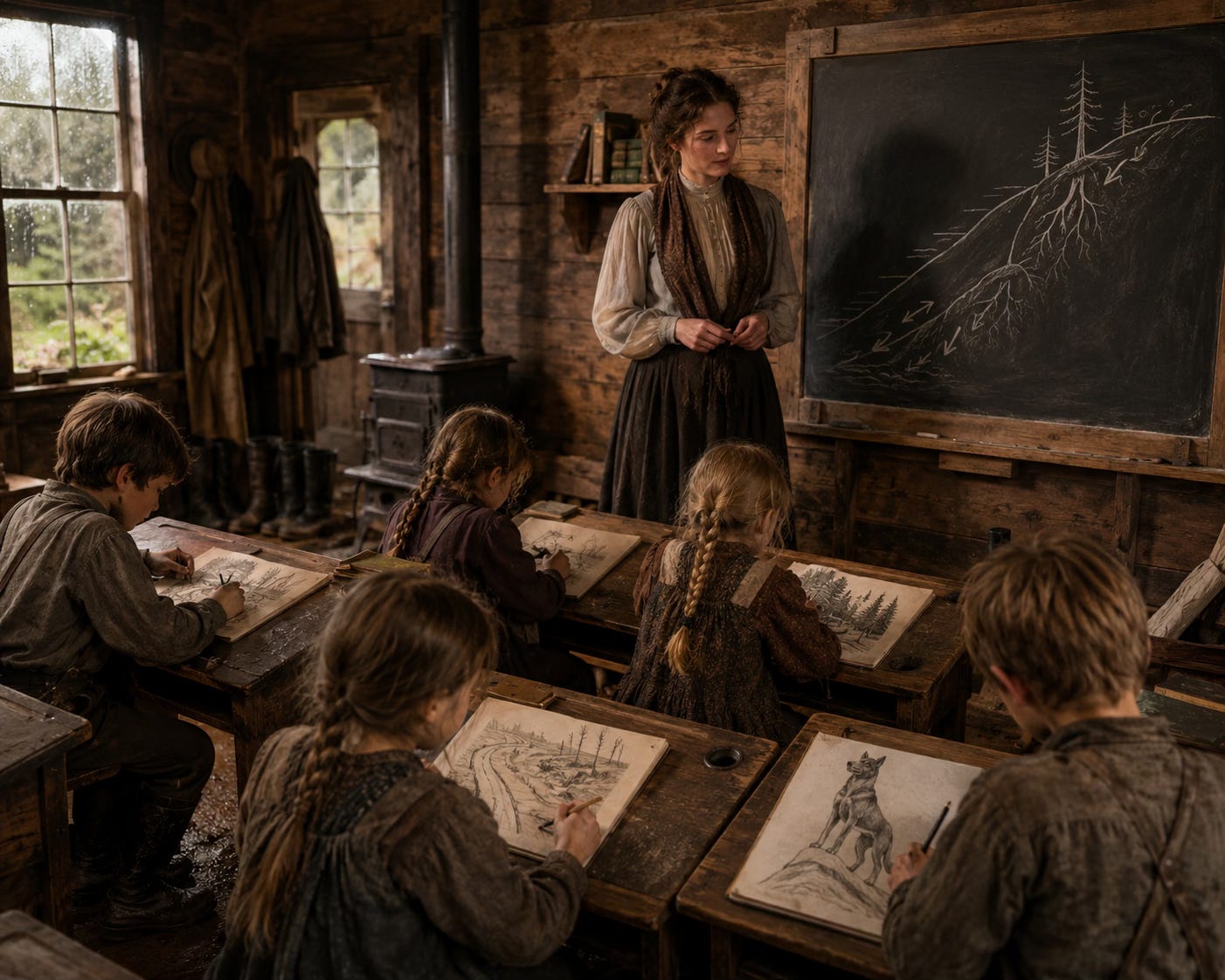
In Emma Everett’s schoolroom, the Ridge enters lessons whether invited or not.
It comes in on boots.
It flakes from hems.
It dries under benches in little brown crescents and waits for sweeping.
The younger children draw it as a hill.
The older children know better.
Anna Grady draws the Ridge with a line for the road and arrows for water. She presses hard enough to nearly tear the paper.
James Carter makes his slope too steep, then defends it by saying the Ridge near the upper road looks exactly that mean.
Martha Carter draws trees first, then roots, then little paths between them. Emma notices the roots are longer than the trunks.
Bobby Jones puts Rusty at the top with his tail raised like a flag.
Rusty, by Bobby’s accounting, is again larger than necessary.
Emma does not correct him right away.
A child can be wrong in proportion and right in protection.
When Emma teaches sums, the Ridge waits behind them.
If a wagon carries so many board feet, and the road loses two hours to mud, and three men must spend half a day clearing a slough, how much timber did impatience truly earn?
The slate does not have room for the whole answer.
No ledger ever does.
Where Weight Goes
The Forest may rise around Timberline.
The River may wait below it.
Tahoma may stand above all of it.
But the Ridge is closest.
It is under every boot, every skid, every wheel rut, every stump, every cabin post, every grave.
Men feel it whether they admit it or not.
In the knees after a climb.
In the shoulders after dragging chain uphill.
In the hush that falls when wet ground shifts.
In the way an old logger tests footing without seeming to test it.
Weight is the Ridge’s language.
That is why pride fares poorly there.
Pride likes clean plans.
The ground prefers proof.
Pride says, “We can still take it.”
The ground answers, “Where will it fall?”
Pride says, “The road held yesterday.”
The mud answers, “It rained last night.”
Pride says, “We need the timber.”
The Ridge asks nothing then.
It simply waits.
And waiting is one of the ways land wins.
By supper, Pete Hawkins had stopped looking embarrassed about the missed cedar.
The men had seen the slide by then.
They had seen the torn root and the dark seam widened into raw earth. They had seen the place where a man might have stood and the mud that covered it after.
Pete sat quieter than usual, both hands around his cup.
Henry Harper broke his biscuit in half and said, to no one in particular, “Good tree can wait.”
Jack looked up from his bowl.
“So can a foolish man,” Maggie said from the stove. “Usually takes him longer.”
That earned the laugh it deserved.
But not a careless one.
Outside, the cedar still stood in the rain, blue ribbon wet against its root flare.
Below it, the torn sidehill lay raw and dark.
The mud had swallowed the place where Pete Hawkins’s boots would have been.
The Ridge does not shout.
It does not explain itself.
It does not forgive a man simply because he was busy.
Tahoma makes men remember their size.
The Ridge makes them answer for their weight.
~ Jay Allen Ford
Next: The Forest
Where every standing tree is more than timber, and every cut leaves a witness.
If Timberline has found a place by your fire, I’d be grateful if you shared it with a friend or family member who might enjoy the trail too.
If you haven’t subscribed to Timberline yet, I’d be glad to have you along for the trail.
Wow! I didn’t understand a lot of what you wrote about, but I could feel it. This line: It measured what it could sell first, because men under debt often mistake price for meaning. So many decisions about how our resources are used lie in that line. I’m excited to learn about this industry and your part of our world.