
The River Had Ears
A Timberline Podcast

Duke (The Smithy) Intro
Every camp has rules.
Some are nailed to a post where a man can read them, provided he has the patience and the letters do not wander on him.
Some are shouted by Jack Mercer when somebody’s boots are pointed the wrong way.
Some are kept by Maggie O’Donnell without ink, paper, committee, vote, or permission from any man drawing breath.
Maggie’s rules were the oldest kind. Kitchen rules. Table rules. Fire rules.
Don’t waste bread.
Don’t crowd the stove.
Don’t lie about how much coffee you took.
Don’t come into her cookhouse smelling like horse unless you were bringing something useful or dying, and even then she expected a decent explanation.
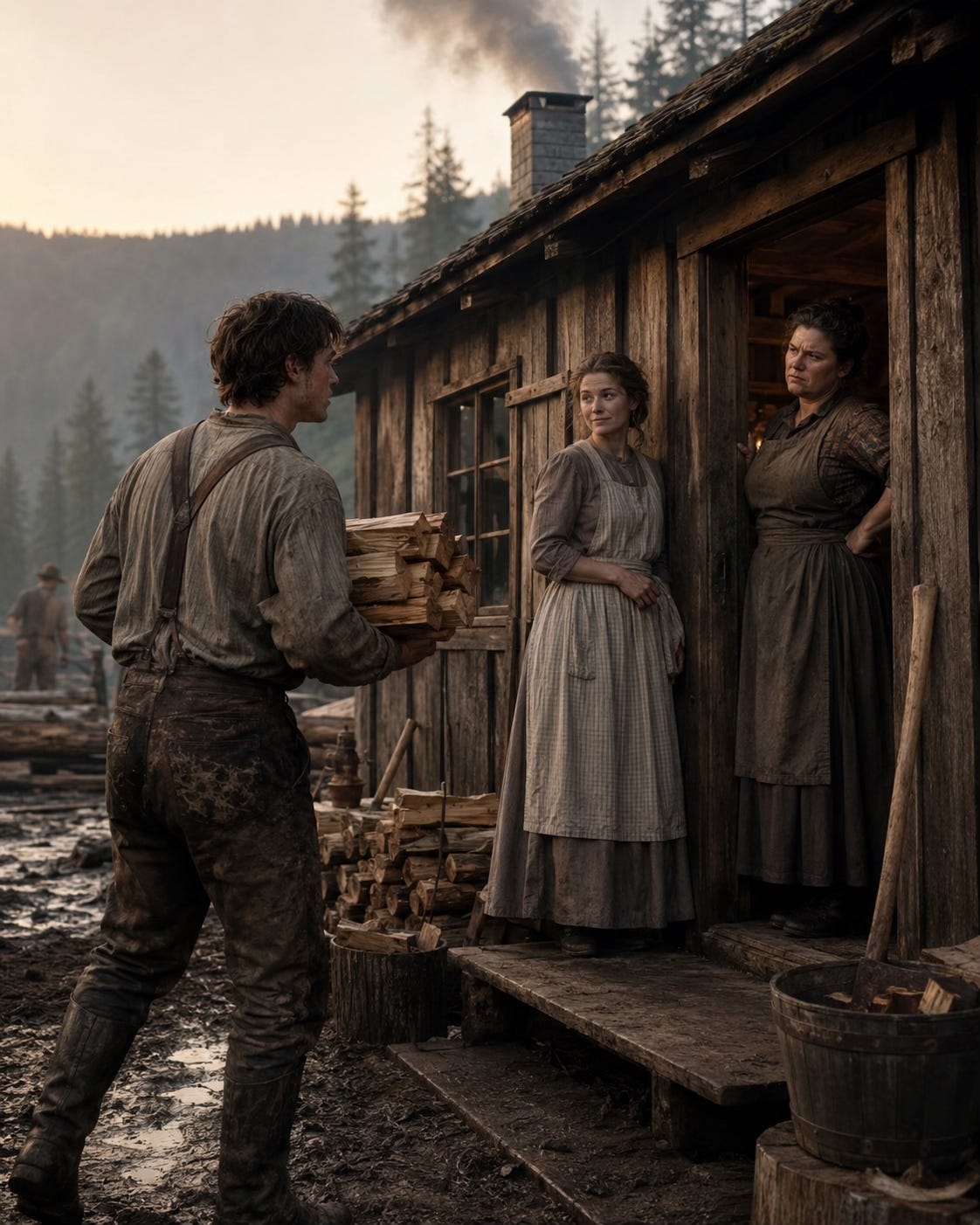
And if a young man started finding reasons to pass that cookhouse door more often than hunger required, Maggie noticed.
Now, I’m not saying Pete Hawkins was sweet on Mae Thompson.
I’m just saying a man does not suddenly become interested in kindling before breakfast unless something besides firewood is warming his thoughts.
He carried split cedar twice in one week.
Maggie had not asked for it either time.
Mae gave him an extra biscuit once and claimed it was cracked.
It wasn’t.
Pete ate it like it had become a legal matter.
After that, he found reasons to be near the wash bench, near the flour sacks, near the back step, and once near a bucket he had no earthly business admiring.
Mae did not say much. That was her way. But she had a sketchbook she kept tucked close, and she saw more than most people guessed.
She drew Rusty asleep by the stove.
She drew Blue Kitty with one paw in a place no cat had permission to be.
She drew Maggie’s hands rolling dough, though she never showed Maggie because Maggie would have said hands were for working, not being made important.
And sometimes Mae went down to the River.
She said the light was better there.
That was true.
It was also quieter.
And quiet, in Timberline, had a way of inviting trouble to sit beside it.
Now, it would be easy to laugh at Pete Hawkins.
Most of us did.
A man carrying kindling to a River deserves some laughter, provided it is done with mercy.
But Mae Thompson was not laughing the same way.
She liked Pete well enough. Maybe more than well enough, though if you said so near Maggie O’Donnell, you had better have a chore in your hands and distance between you and the nearest spoon.
But liking a person and being free to stand alone with him were not the same thing.
Not in a camp.
Not in 1892.
Not for a young woman sleeping under Maggie’s roof, earning her place by flour, fire, and good conduct.
A man could be foolish and still come back as himself.
A woman could be careful and still come back carrying a story somebody else had written for her.
That is a hard sentence, but Timberline was built in a hard year, and 1892 did not hand women much room to be misunderstood safely.
Mae knew that.
Pete did not.
Not yet.
So when Mae went down to the River with her sketchbook under one arm and flour still pale on her sleeve, the trouble had already started walking before Pete ever found the path.
And the River?
The River had ears.
Mae Thompson went to the River with her sketchbook under her arm and flour still pale along the cuff of her sleeve.
She had told Maggie she wanted to draw the bend below the Mercer cabin while the evening light still held. That was true enough to stand on. Maggie trusted true enough more than most lies, but less than plain truth.
“You keep to the open bank,” Maggie had said.
Mae tied her shawl at her throat. “Yes, ma’am.”
“And you come back before the lamps need trimming.”
“Yes, ma’am.”
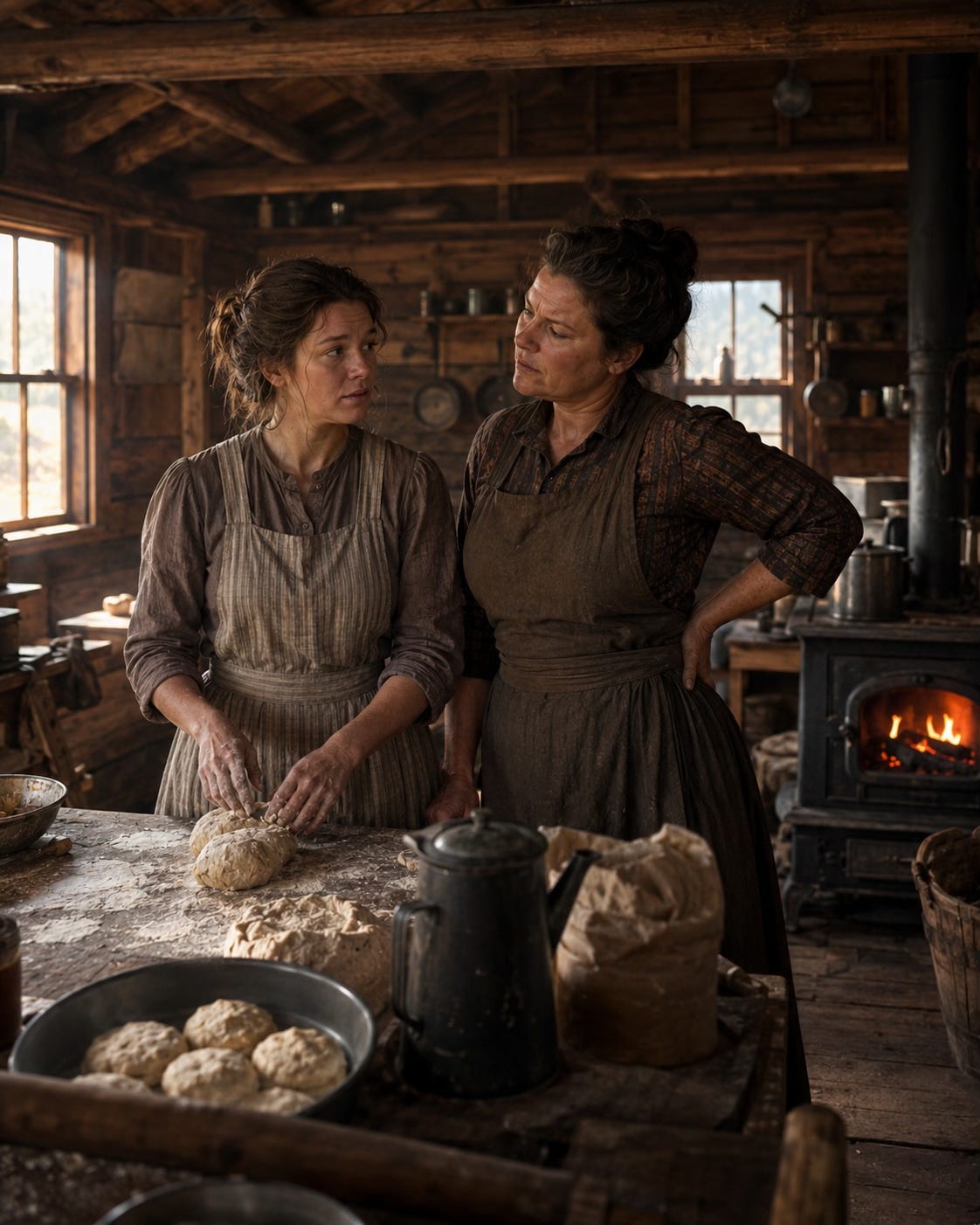
Maggie did not look up from the dough. “And if a certain boy with ears too large for his sense happens to wander down there, you remember sound carries over water.”
Mae felt warmth rise to her cheeks. “I’m going to draw.”
“I did not ask what excuse you were carrying.”
Blue Kitty sat near the flour bin, washing one paw with the smug patience of an animal who had never once been held accountable.
Mae slipped out before her face gave Maggie any more evidence.
The path to the River ran behind the cookhouse, past the stacked kindling, through sword ferns wet from afternoon rain. Timberline quieted differently near the water. Camp sounds thinned there. Ax rings softened. Voices broke apart. The River took everything offered to it and carried it away before anyone could make a proper argument.
Mae liked that.
The Mercer cabin stood above the bend, tucked back among fir and cedar, close enough for smoke to drift down when the wind turned. Jack and Sam still shared it, which meant the River below was not as private as it looked.
Mae knew that.
Still, the light was good there.
She found her place beneath a leaning alder where the bank stayed firm and the River turned silver between stones. Across the water, the Mountain was not visible, but Mae could feel it all the same, the way a person could feel someone standing behind a closed door.
She opened her sketchbook.
At first she meant to draw the River bend.
Then her pencil found Maggie’s hands.
She smiled despite herself and drew the thumb pressed into dough, the knuckles strong, the wrist turned firm over the board.
Maggie would hate it.
That made Mae like it more.
A twig snapped behind her.
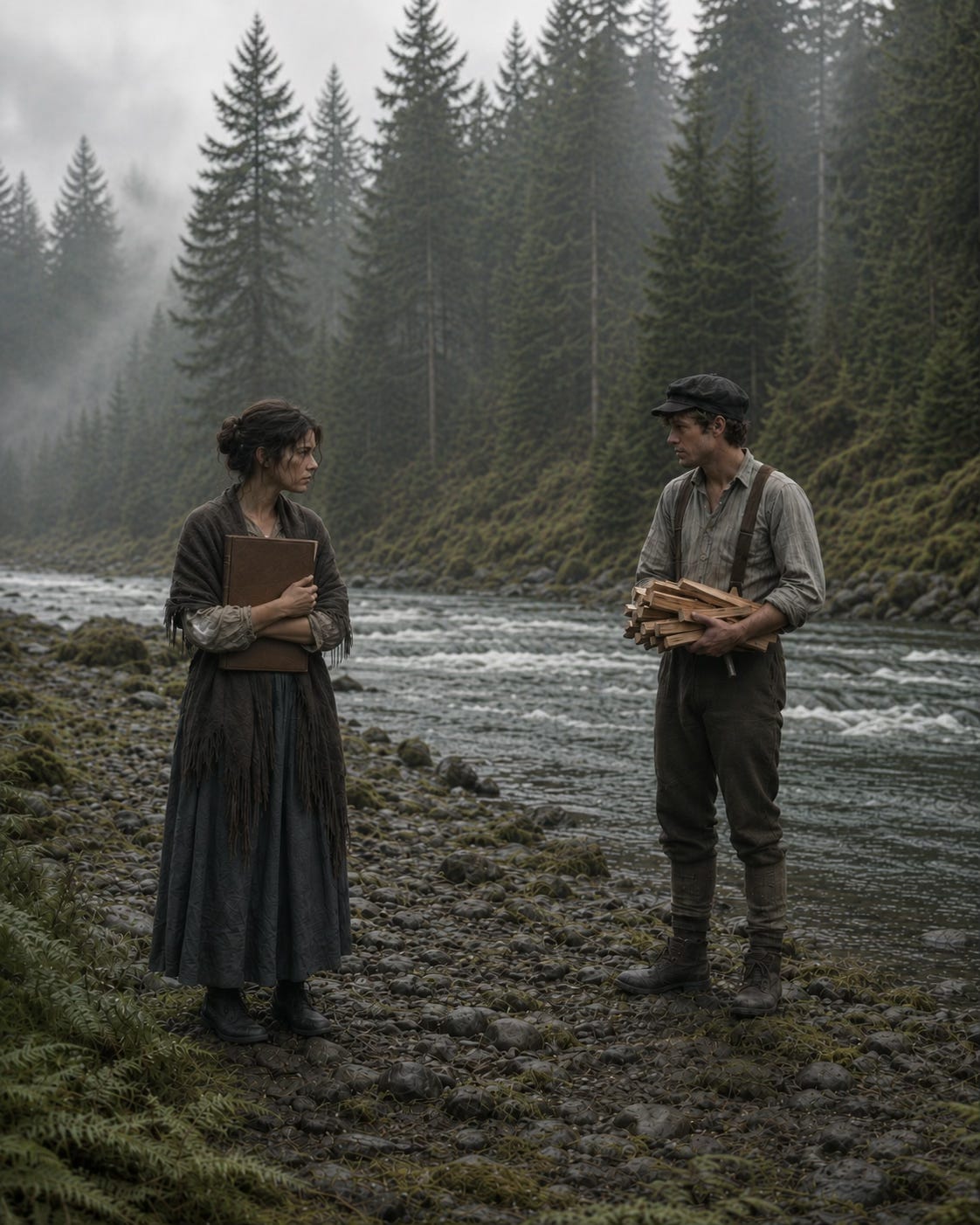
Mae closed the sketchbook so fast the paper slapped.
Pete Hawkins froze halfway down the path with a bundle of cedar splits under one arm.
For a moment neither of them spoke.
The River did.
Pete looked at the wood, then at Mae, then at the water, as if one of the three might offer him a useful reason for being there.
“I was bringing kindling,” he said.
Mae glanced at the River sliding cold over stone.
“To the River?”
Pete looked down at the cedar in his arms.
“It seemed short.”
Mae pressed her lips together.
Pete saw her trying not to smile and looked both pleased and doomed.
“I mean, not short of wood. Short of—” He stopped. “That was worse.”
“A little.”
He shifted the cedar to his other arm. “I wanted to ask if you might show me what you draw sometime.”
That took the smile from her face, but not in an unkind way.
He had said it plainly. No teasing. No grabbing. Just asking, as if the pages mattered because she had made them.
Mae looked down at the sketchbook against her skirt.
“I don’t show many people.”
“I wouldn’t tell.”
“That is not the only trouble.”
Pete frowned. “There’s other trouble?”
Mae looked at him then, really looked, and the question in his face made her tired in a way she had not expected. Not angry. Not exactly. Just tired of knowing a thing he had never had to learn.
“You should not be here alone with me,” Mae said.
Pete’s face changed. Hurt first. Then confusion.
“I wasn’t meaning anything wrong.”
“I know.”
“I wouldn’t.”
“I know that too.”
“Then why does it matter?”
“Because meaning does not always get asked first.”
Pete stared at her.
The River moved over stone, quick and silver, as if it had somewhere else to be.
Mae held the sketchbook tighter against her skirt. “If Jack or Sam find you here, you get laughed at. Maybe scolded. Maybe Maggie gives you a look over supper and you wish you had drowned first.”
Pete glanced toward the trees, uneasy now.
“But tomorrow,” Mae said, “you are still Pete. Foolish Pete, maybe. Wet Pete, if you keep standing that close to the bank. But still yourself.”
His mouth opened, then closed.
Mae looked down at the flour pale along her sleeve. “I come back different.”
“You wouldn’t.”
“I wouldn’t have to. Other people would do it for me.”
Pete went still.
“One person sees us,” she said, “and by supper I am not Mae with a sketchbook. I am Mae who went alone to the River with Pete Hawkins. By breakfast someone decides I must have wanted you to follow. By dinner tomorrow someone remembers I smiled at you once over biscuits, and now that smile has a meaning I never gave it.”
Pete’s face lost color in small stages.
Mae hated that she had to say it. Hated that saying it made the River feel less like hers.
“I sleep in Maggie’s cookhouse,” she said. “I work under her roof. I have my place because she trusts me. Because people trust what they think they see when they look at me.”
“I wouldn’t speak against you,” Pete said.
“No. But silence does not stop talk. Sometimes silence feeds it.”
He looked down at the cedar splits in his arms as if they had become evidence against him.
“I only wanted to ask about your drawings.”
“I know.”
“That’s all.”
“I know that too.”
His voice dropped. “But all isn’t always all.”
Mae looked up.
The words had cost him something. She could see it. The shame was not the quick kind now, not boyish embarrassment over being caught with a poor excuse. This was slower. He was seeing the shape of the thing, and the shape was ugly.
“No,” she said. “Not for me.”
Pete swallowed.
“I’m sorry.”
She wanted to forgive him at once. That was the dangerous part. She wanted to make him smile again, to let the awkwardness lift, to tell him she knew he had meant kindly.
But kindness without care could still leave marks.
So she made herself stand in the harder truth.
“If you care for me at all,” she said, and the words warmed her face as they left her, “you have to care about what follows me back when you walk away.”
Pete’s grip tightened on the kindling.
“I do.”
Mae believed him.
That made it worse.
“Then don’t ask me to be brave in ways you don’t have to be.”
The River kept moving.
Pete nodded once, slow and ashamed.
“I didn’t think.”
“I know.”
“That makes it worse, doesn’t it?”
“A little.”
He accepted that too.
And because he accepted it, because he did not argue or laugh or tell her she was making too much of nothing, Mae felt the first careful mercy rise in her.
“You may ask about the drawings,” she said.
Pete looked at her.
“Not here,” she added.
“No,” he said quickly. “Not here.”
“And not alone.”
“No.”
“And not with kindling for a River.”
He almost smiled.
Almost.
Then the brush behind him said nothing at all.
That was the first warning.
Pete turned.
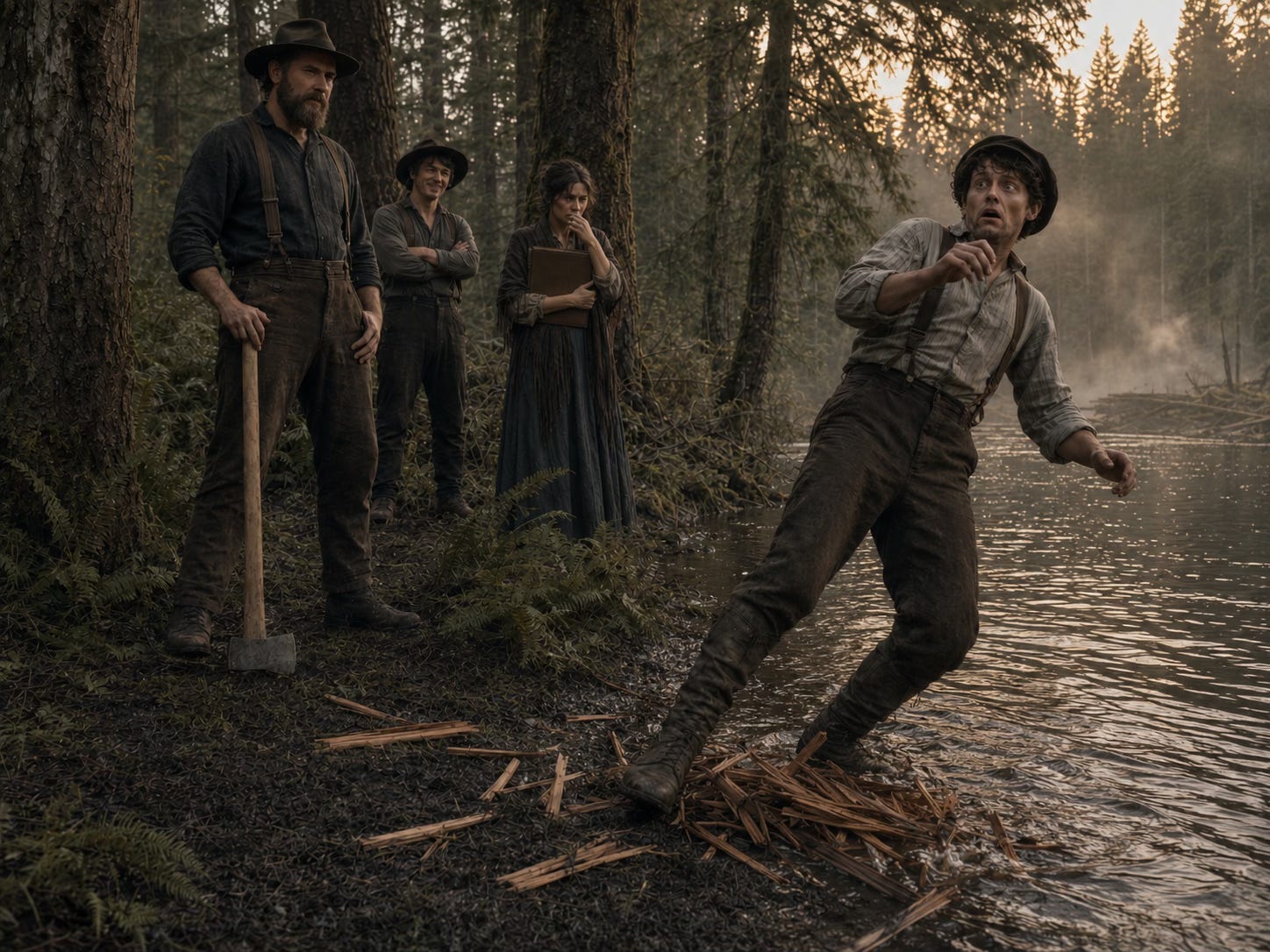
Jack Mercer stood between two firs with one hand resting on the head of his ax.
Sam stood just behind him, arms folded, looking like a man who had arrived early to a sermon and found it better than expected.
Pete dropped the kindling.
Every stick hit the ground at once.
Mae flinched.
Pete backed away.
“Mr. Mercer.”
Jack did not move.
“Pete.”
There were men in Timberline who could shout a man backward.
Jack did not need to.
Pete took one step back.
Then another.
Sam’s eyes flicked past Pete’s shoulder to the water.
“Pete,” Sam said, too mildly.
Pete did not hear him. His attention was fixed on Jack, whose face had not changed enough to count as mercy.
“I brought kindling,” Pete said.
Jack looked at the scattered cedar splits.
Then at the River.
“For the fish?”
Sam turned his head.
His shoulders moved once.
Mae bit the inside of her cheek.
Pete took another step back.
His heel found mud.
The mud found no loyalty in itself.
Pete’s arms went out.
For one long second, he seemed to be negotiating with the entire earth.
Then he sat down backward into the River.
The splash was not large.
That made it worse.
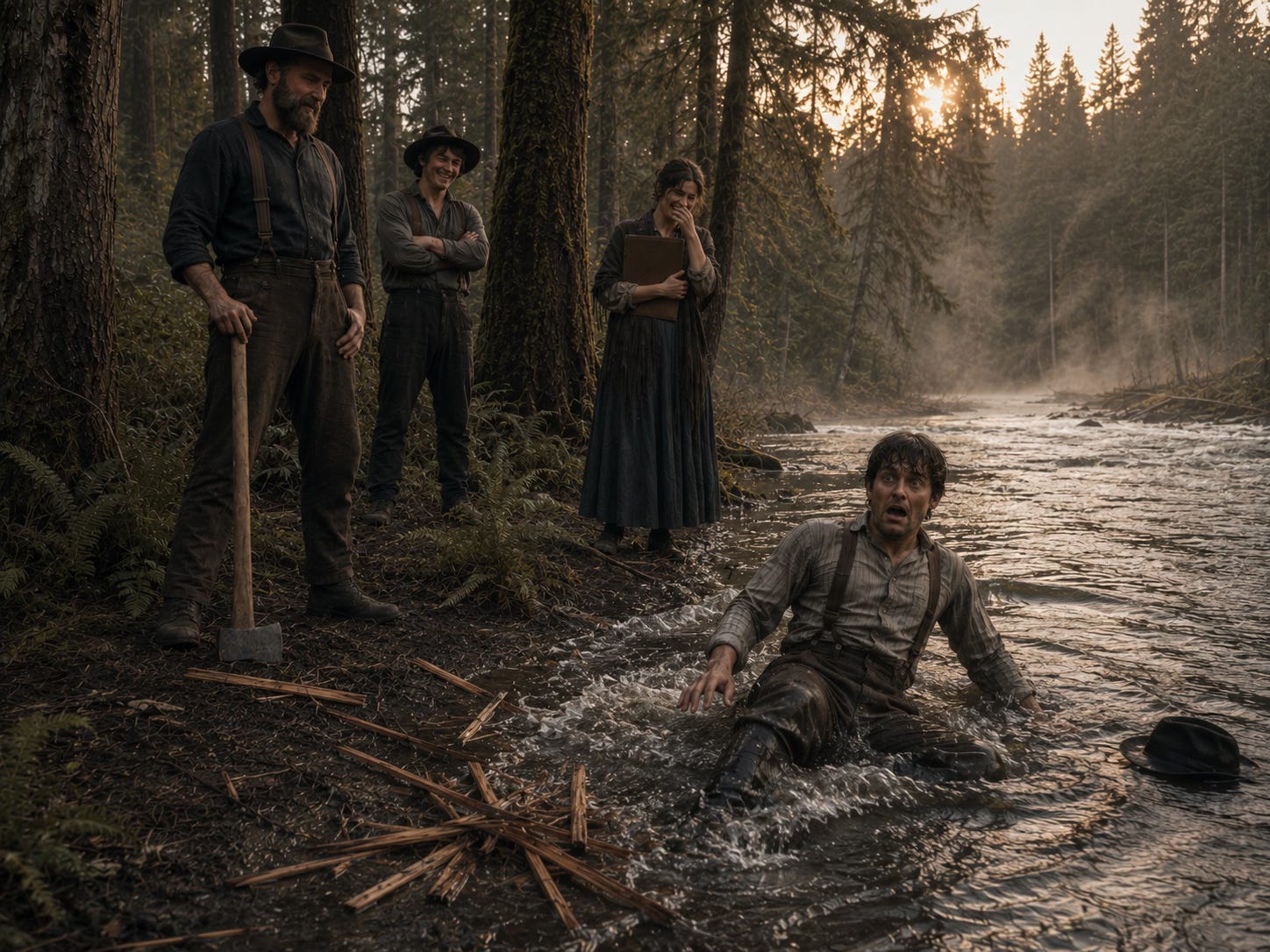
Water came up around his waist, cold enough to take the bravery out of any man and most of the grammar.
Pete stared at Jack from the shallows, soaked to the ribs, hat floating beside him.
No one spoke.
The River went on speaking because it had no manners.
Sam covered his mouth with one hand.
Mae looked down at her sketchbook, but her shoulders betrayed her.
Jack regarded Pete for a moment.
Then he said, “That kindling wet now?”
Pete closed his eyes.
“Yes, sir.”
“Pity.”
Mae made a sound she tried to turn into a cough.
It did not survive the attempt.
Pete looked at her.
She was laughing now, not cruelly, but with her whole face lit in a way he had never seen across the dining hall. It made the River seem less cold and more impossible.
Jack glanced at Mae.
“Ms. Thompson.”
She straightened at once. “Mr. Mercer.”
“You all right?”
“Yes, sir.”
“You sketching?”
“Yes, sir.”
“Good light here.”
“Yes, sir.”
Jack nodded once. “Poor place for kindling.”
Pete, still seated in the River, whispered, “Yes, sir.”
Sam stepped down the bank and picked up Pete’s hat before it could drift away.
“Best get up,” Sam said. “Maggie sees you dripping in her cookhouse, she’ll think you drowned on purpose to avoid work.”
Pete stood, water running from his shirt, trousers, boots, and what little dignity he had brought with him.
He looked at Mae. “I’m sorry.”
Mae’s laughter softened.
“I know.”
This time the words gave him something back.
Jack pointed up the trail. “You walk ahead.”
Pete gathered what wet kindling he could.
Sam handed him the hat.
Pete put it on without looking to see if it still had shape.
It did not.
Mae watched him climb the bank, dripping and miserable and somehow dearer than he had been when he arrived dry.
Before he disappeared into the trees, Pete looked back once.
Mae did not smile this time.
She only lifted two fingers from the sketchbook.
That was enough to send him stumbling into a fern.
Mae stayed by the River after they were gone.
Not long.
Long enough for the sound of Pete’s wet boots to fade up the trail. Long enough for Jack’s low voice to become only a shape among the trees. Long enough for Sam’s laugh to finally break once, quickly muffled, and vanish into the timber.
Then the River had the bank again.
Mae opened her sketchbook.
Her hand trembled once before settling.
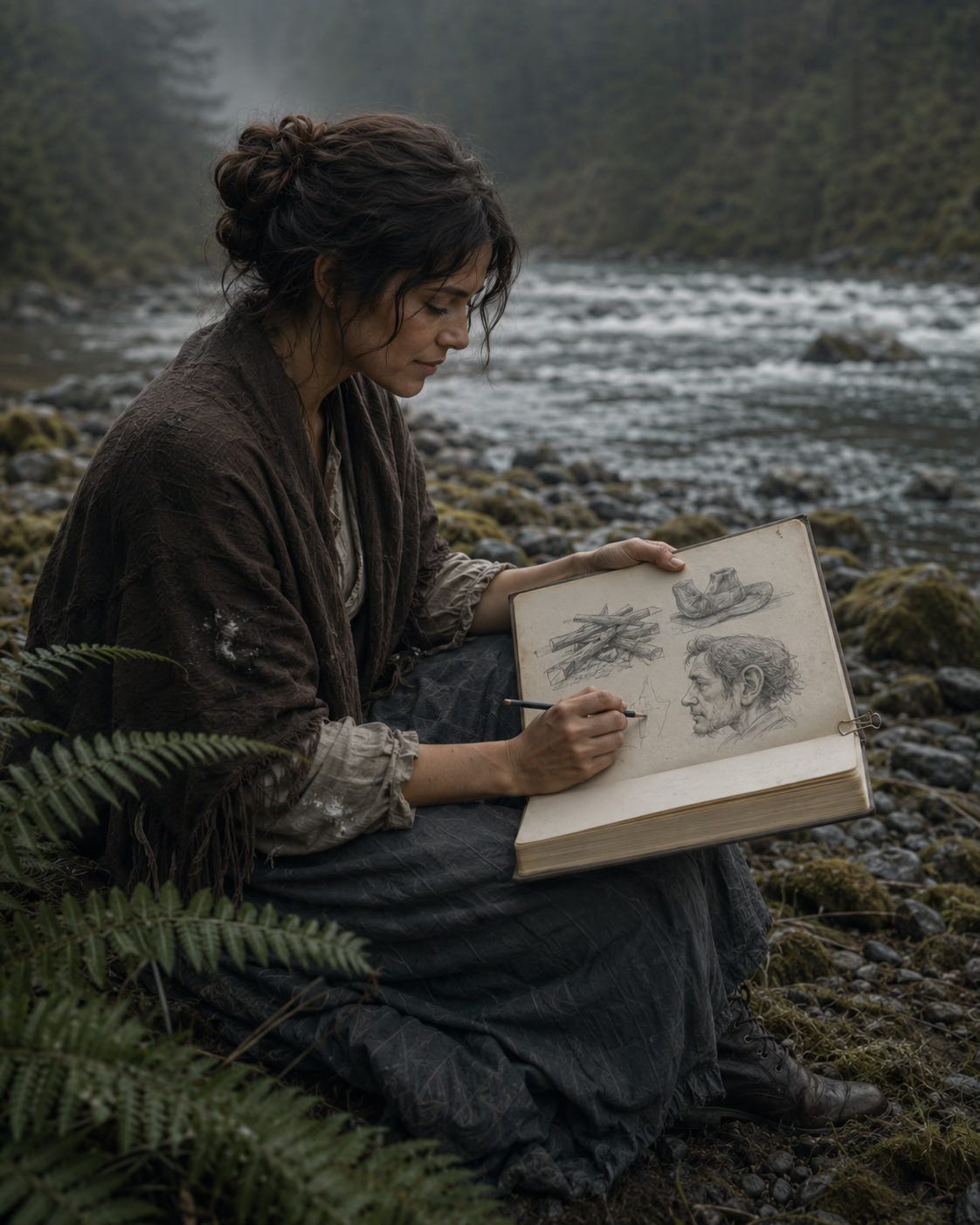
On the next blank page, she drew the cedar splits first, scattered along the mud where no kindling had any reason to be.
Then she drew Pete’s hat, bent along the brim and dripping at one side.
Then she paused.
It would have been easy to draw him foolish.
Too easy.
Pete Hawkins had given her plenty to work with.
But he had also listened.
He had stood there with shame rising in his face and had not told her she was wrong. He had not laughed. He had not made her smaller so he could feel less foolish.
That mattered.
Mae looked toward the path where he had gone.
The River moved on, silver and cold, carrying every sound away except the ones that stayed.
She turned the page slightly and drew Pete as he had looked before Jack appeared: kindling in his arms, fear nowhere on him yet, asking about her drawings as if they mattered.
Only then, small in the corner, she drew his ears.
She made them only a little too large.
Timberline Note
Pete brought kindling to the wrong place, but he learned the right lesson.
In Timberline, care has to become more than feeling. It has to learn what it costs the other person.
That is where this little River trouble begins to matter.
Good stories don’t stay by the fire. If this one made you laugh, wince, or feel a little mercy for Pete Hawkins, pass it downriver.
love the ending!
this would make an excellent reader magnet for your website - and I am intrigued by the idea that this was superfluous to the book...